In each sector, organisations get the system they want, own it fully, and pay much less than rental. One shared hub supports every system.
Hub partners own their system: the code, the data, the instance, as well as self host if they wish. Of course, ownership continues if the partner leaves the partnership.
Partners pay a flat annual fee and fees for build work. The board agrees the fee against the running cost of their hub. Each new partner decreases the fee for all.
All partner systems use Technology DNA's shared dictionary, so a record means the same thing in every build. Partners can share data with each other with no integration work. Each partner decides what it shares.
Partners can compare live anonymised aggregate data across the partnership: costs, activity, outcomes. Partners can improve relative to each other and as a sector on the whole, eg evidence for regulators and funders.
Vet practice management software covering patient records, clinical workflows, dispensing, billing, vet booking system, and client communication. Built on Technology DNA, around how your practice actually operates.
A veterinary practice generates a particular kind of complexity. Whether you call it veterinary software, vet practice management software, or a veterinary practice management system, the core problem is the same. Every consultation produces clinical notes, treatment records, dispensing actions, invoices, and follow-up tasks. Multiply that across dozens of patients per day, several vets and nurses, walk-ins, emergencies, lab results arriving asynchronously, and you have a data management problem that paper and spreadsheets cannot solve. See our comparison of veterinary software (PIMS) and our guide to Provet Cloud alternatives for the main UK options.
At minimum, vet practice management software needs to handle:
More advanced systems also cover laboratory integrations, diagnostic imaging workflows, referral letter generation, clinical outcome tracking, multi-branch management, and business analytics covering revenue per vet, average transaction value, and client retention rates.
A simple demo for vets. Open it as a vet and log a consultation with dispensing, or as the client and book online. It runs the core practice workflows:
We build your system around your practice and you own it outright. The build cost is upfront, but over two to three years you save significantly against subscription fees.
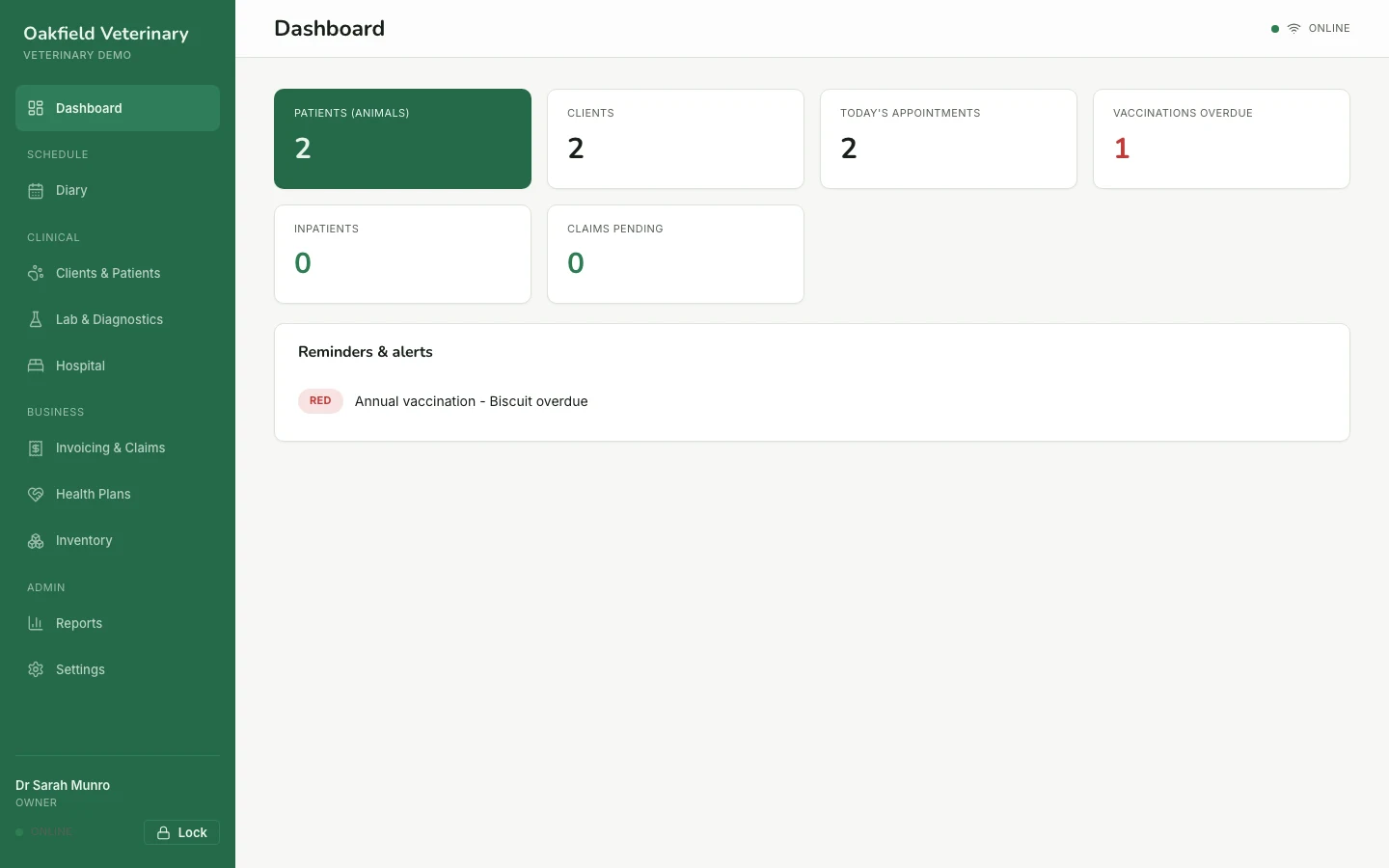
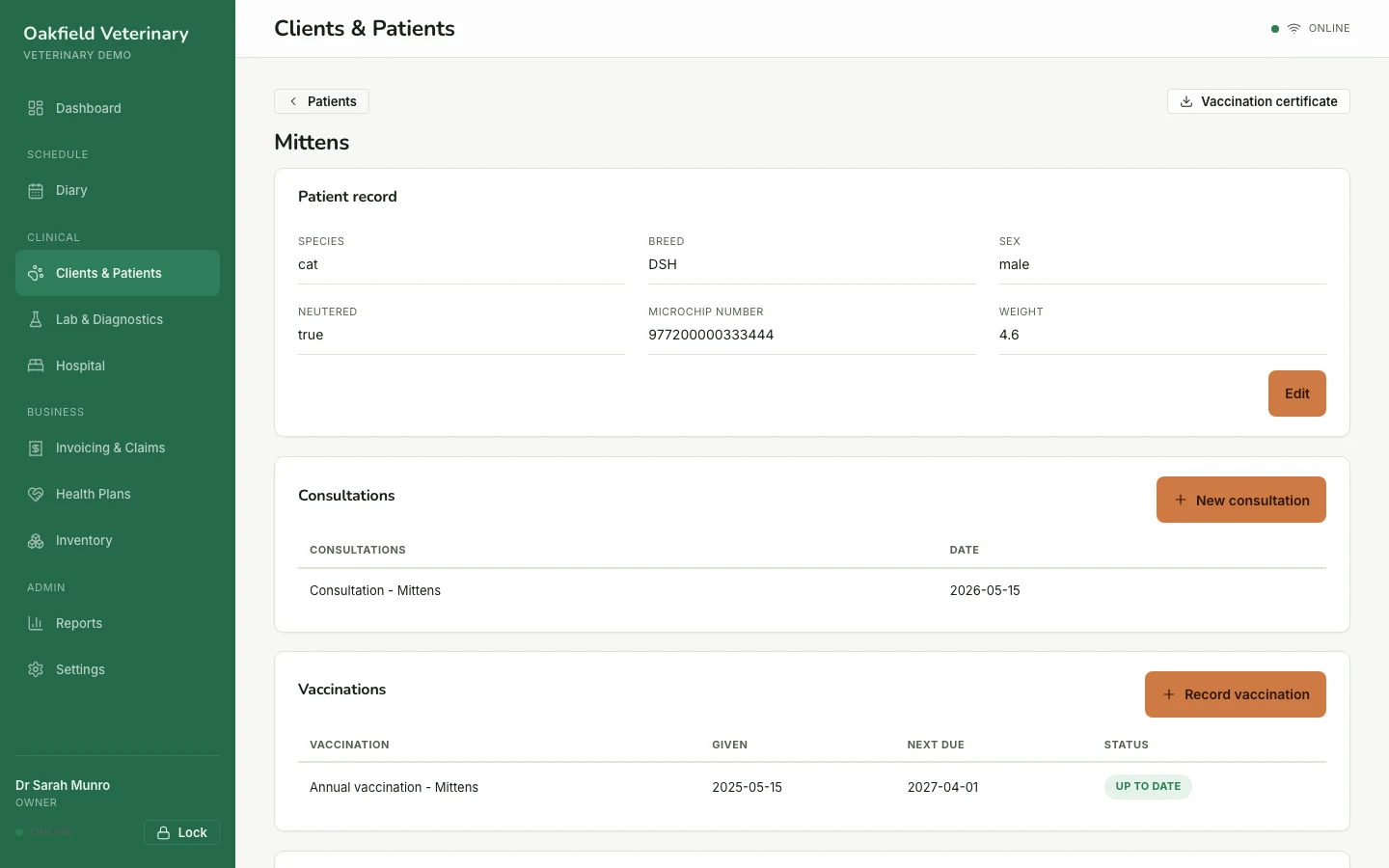
A simplified live demo. Choose a user to explore as, no login needed. Open full screen →
The UK veterinary PMS market is concentrated around a small number of vendors. Several are owned by the same parent companies that also sell diagnostics, pharmaceuticals, and consumables to veterinary practices. Here is what is available and what each one actually delivers.
| Provider | What They Offer | Pricing | Watch Out For |
|---|---|---|---|
| RxWorks (Covetrus) | Full PMS with patient records, invoicing, stock control, and reporting. On-premise with some cloud features. Widely used across UK practices. Owned by Covetrus, which also sells pharmaceuticals and consumables to vets. | Not publicly disclosed. Subscription-based. Contact for quote. | Vendor lock-in risk. Covetrus sells drugs and supplies alongside the software, creating a bundled dependency. Legacy codebase with limited modern UX. |
| Animana (IDEXX) | Cloud-based PMS built for practices of all sizes. Scheduling, records, invoicing, stock, client communication. Owned by IDEXX, which also manufactures diagnostic equipment and lab analysers. | Competitively priced. Per-user subscription. Contact for quote. | IDEXX owns both the software and the lab equipment it integrates with. Cloud-only means you depend on IDEXX servers. Data portability is limited. |
| Rapport (Covetrus) | Client communication platform with automated reminders, two-way messaging, and online scheduling. Integrates with RoboVet and other Covetrus systems. Not a full PMS on its own. | Not publicly disclosed. Subscription-based. | Only works properly with other Covetrus products. Not a standalone solution. Adds another subscription on top of your PMS. |
| VetIT | Cloud-based PMS with scheduling, billing, stock control, and client engagement. Modern interface. Mobile app for off-site working. Used by small and mixed-animal practices across the UK. | Not publicly disclosed. Subscription-based. No free trial. | Limited advanced reporting. Customisation options are restricted. Newer entrant with a smaller user base than the incumbents. |
| PetsApp | Client communication and engagement platform. Messaging, appointment booking, prescription requests, payments, and an AI note-taking assistant. Used by over 2,500 veterinary professionals. | Not publicly disclosed. Subscription-based. | Communication layer only. You still need a separate PMS. Another subscription to manage alongside your core system. |
| Shepherd | Cloud-based PMS with SOAP workflows, client portal, inventory tracking, and AI-assisted note generation. Modern design. Built-in payment processing. | From approximately $299/month (US pricing). UK pricing not published. | US-focused product. UK regulatory compliance (VMD, RCVS) may not be fully addressed. High payment processing fees. |
A pattern emerges. The two largest PMS vendors in the UK, Covetrus and IDEXX, are not just software companies. They are veterinary supply chains. Covetrus sells pharmaceuticals, consumables, and prescription management alongside RxWorks. IDEXX manufactures the diagnostic machines that Animana integrates with. The software becomes a mechanism for locking practices into a broader commercial relationship.
The CMA's 2024-2026 investigation into the UK veterinary market highlighted exactly this kind of consolidation. Corporate groups now own over 60% of UK practices, and the CMA found that large groups charge more on average than independents. The same consolidation dynamic applies to the software market.
The platforms listed above are functional products. They work. But they were designed for a generalised version of a veterinary practice, and no two practices are general.
A small-animal clinic in a suburban high street operates differently from a mixed-practice covering farm calls across three counties. An equine hospital with surgical theatres and MRI has different workflow requirements from a charity clinic doing high-volume neutering. A practice with four branches needs centralised stock control and cross-site patient records. A single-vet independent needs simplicity, not a system designed for enterprise scale.
What typically happens is this: you adopt the PMS, go through a weeks-long implementation process, and then discover it does not quite match how your practice runs. The consultation workflow assumes a sequence your vets do not follow. The dispensing module does not handle your controlled drugs procedure correctly. The lab integration works with IDEXX analysers but not the Heska machine you already own. The reporting gives you metrics someone else decided were important, not the ones you actually need.
Then there is the control problem. When IDEXX decides to change Animana's interface, you adapt or leave. When Covetrus increases RxWorks pricing, you pay or migrate. When a vendor sunsets a feature you depend on, you lose it. Your patient records, the clinical data your practice has built over years, live on someone else's servers under someone else's terms.
For independent practices, this matters more than it might seem. The CMA investigation found that corporate acquisitions often come with software changes imposed from above. If you are independent and want to stay that way, your software should not be a dependency that a vendor or corporate group can use as leverage.
A bespoke system starts with your practice. Not a product demo. Not a feature list designed for a general audience. Your actual daily workflow, from morning rounds to evening close, including the edge cases and exceptions that off-the-shelf software was never designed to handle.
We sit down with your clinical and administrative team and map exactly how your practice operates. Then we build a system that matches it precisely. The result is software where every screen, every form, and every workflow reflects the way your people actually work.
Every system starts with your specific requirements. Here are examples of what your system could include:
Apply to become a veterinary design partner · · Replies within 24 hours
The veterinary software market is in the middle of a transition from legacy systems to cloud-based platforms. Cloud-based solutions are the fastest-growing segment, driven by remote access, automatic updates, and lower upfront infrastructure costs. The UK is leading this shift in Europe.
But the way most vendors implement cloud hosting comes with trade-offs that are rarely discussed upfront.
When your PMS is cloud-based and hosted by the vendor, your data lives on their servers. You access it through their application. If they experience downtime, your practice stops. If they change their terms, you comply or leave. If they are acquired (as happens regularly in this market), your data transfers to the new owner whether you agreed to it or not.
A bespoke system gives you the benefits of cloud without the dependency. Your system is hosted on secure UK-based servers. Your data belongs to you. Every change is recorded in real time to a write-ahead log (WAL), so nothing is ever lost. You can also back up locally on a schedule for additional peace of mind. If you want to move providers, your data comes with you because it was always yours.
ESRE builds veterinary practice systems for a one-off cost. No monthly subscription. No per-user fees. No price increases tied to your practice growing or adding staff.
A vet practice does not just pay for a PIMS. Most practices run several separate subscriptions, each covering a different part of the operation. For a typical single-site small animal practice, the monthly spend commonly looks something like this.
| System | Typical Monthly Cost | Examples |
|---|---|---|
| Practice management (PIMS) | £200 to £500 | ezyVet (from ~$245/mo), Animana, Provet Cloud, RxWorks |
| Client communication | £80 to £200 | PetsApp, Vet-AI Joii, or PIMS add-on module |
| Online booking | £50 to £100 | Vetstoria, PetDesk, Vello, or PIMS add-on |
| CMA compliance (from 2027) | £29 to £50 | VetComply, Digital Practice (when live) |
| Accounting | £25 to £45 | Xero, QuickBooks, Sage |
| Total monthly cost | £384 to £895 | |
| Five-year total | £23,040 to £53,700 |
Each of these systems holds a different slice of the practice's data. Client contact details in the PIMS. Communication history in PetsApp. Booking data in Vetstoria. Compliance evidence in VetComply. Financial data in Xero. None of them share data without manual effort or fragile integrations that break when one vendor updates their API.
| System Scope | Typical One-Off Cost | Replaces |
|---|---|---|
| Core: patient records, scheduling, clinical notes, invoicing, reporting | £10,000 to £18,000 | PIMS subscription + accounting workarounds |
| Full: above plus dispensing, client communication, online booking, CMA compliance | £18,000 to £35,000 | All five subscription categories above |
| Multi-site: full system across 2 to 6 branches with centralised patient records | £30,000 to £65,000 | Per-site subscriptions multiplied across locations |
A practice paying £500 per month across its tools spends £30,000 over five years and owns nothing. A bespoke system at £25,000 pays for itself in under three years, replaces every subscription, and belongs to the practice permanently. After year three, every month is pure savings.
Every system we build, the client owns all the code. There is no vendor lock-in. No proprietary platform you depend on. No API that disappears when a vendor changes direction or gets acquired.
This matters especially in veterinary software, where the two dominant vendors are also the companies selling you diagnostics and pharmaceuticals. When your PMS is owned by the same company that sells you lab machines and drugs, the incentives are not aligned with your independence. A bespoke system removes that conflict entirely.
What we build is not one screen. It is a connected data architecture from which multiple applications emerge. Patient and client data is entered once and appears wherever it is needed.
All of these surfaces draw from the same data. A prescription written during a consultation is immediately visible in the dispensing screen, on the client's record, in the invoice, and in the CMA price list data. No syncing between separate systems.
We train you and your team to evolve the system using AI. Since December 2025, AI tools have reached the maturity to work reliably alongside people for maintaining and extending systems. We set up your AI to understand your specific codebase, with failsafe environments, version control, and automated backups.
Because Technology DNA already holds the data architecture, adding new functionality is straightforward. Need to add telemedicine consultations? They connect to the same patient records. Want a pet care plan module with comparison pricing for CMA compliance? It draws from the same fee schedule. Adding a referral management workflow? It links to the existing clinical history. Technology DNA is the foundation. Everything after that is incremental, and much of it can be done in-house with the tools we provide.
See examples of what we build across different sectors.
VetSoft, RxWorks, IDEXX, and Vet-Advantage all charge monthly. A bespoke clinical system that fits your workflow exactly, owned outright for a one-off build cost.
Cascade prescribing records, SIC/SAES evidence, controlled drug registers. Compliance is in the architecture, not a checklist maintained separately from clinical workflow.
Every clinical entry, dispensing record, and access event recorded and immutable. Rollback to any point. The RCVS evidence burden handled at the data layer.
Describe the consultation, the system structures it into a SOAP note, flags recalls, and links to the patient record. Not a third-party subscription. Built into the system itself.
A core veterinary PMS typically takes six to ten weeks from first conversation to live deployment. More complex systems with lab integrations, dispensing modules, multi-site features, and data migration from existing platforms take ten to fourteen weeks.
Yes. We regularly import data from RxWorks, Animana, VetIT, and other systems. Patient records, client data, clinical histories, and financial records transfer into the new system cleanly. The goal is a complete transition with no data loss and minimal disruption to your practice.
RCVS record-keeping requirements are built into the system from the start. Clinical records include the fields the RCVS expects: patient identification, clinical findings, treatments administered, medicines dispensed, informed consent records, and audit trails. The system enforces completeness so records meet the standard without extra effort from your vets.
Yes. We build integrations with IDEXX, Heska, Fuji, and other diagnostic platforms. Lab results flow directly into patient records. The system is not locked to any single equipment manufacturer, so if you change analysers in the future, the integration changes with you.
We are always available for support, changes, and enhancements. But because you own the code and we train your AI to understand it, you are not dependent on us for day-to-day changes. That is the point. You can add new templates, adjust workflows, and modify reports without waiting for a vendor's development roadmap.
Your system is cloud-hosted on secure UK-based servers. Your data belongs to you. Every change is recorded in real time to a write-ahead log (WAL), so nothing is ever lost. You can also back up locally on a schedule for additional peace of mind.
Yes. There is a live veterinary demo you can open now, without a login. Open it as owner, vet, nurse, receptionist or client and use a working system. It is free to try; a production build is a one-off project that you own.