In each sector, organisations get the system they want, own it fully, and pay much less than rental. One shared hub supports every system.
Hub partners own their system: the code, the data, the instance, as well as self host if they wish. Of course, ownership continues if the partner leaves the partnership.
Partners pay a flat annual fee and fees for build work. The board agrees the fee against the running cost of their hub. Each new partner decreases the fee for all.
All partner systems use Technology DNA's shared dictionary, so a record means the same thing in every build. Partners can share data with each other with no integration work. Each partner decides what it shares.
Partners can compare live anonymised aggregate data across the partnership: costs, activity, outcomes. Partners can improve relative to each other and as a sector on the whole, eg evidence for regulators and funders.
Physiotherapy clinic management software covering online booking, clinical notes, exercise prescription, insurance billing, and patient communication. Built on Technology DNA, around how your clinic actually operates, including the generic terms clinics search for such as clinic management software.
A physiotherapy clinic generates a particular kind of complexity. Whether you call it physiotherapy software, physio clinic management software, or patient management software for physiotherapists, the core problem is the same. Every appointment produces clinical notes (usually SOAP), an exercise prescription or treatment plan, an invoice, possibly an insurance claim, and recall or follow-up tasks. Multiply that across a full diary, several clinicians, self-referrals, DNA rates to track, private medical insurance (PMI) authorisations, and outcome measures for commissioners or insurers, and you have a data management problem that paper and spreadsheets cannot solve. See our comparison of physiotherapy software for the main UK options.
At minimum, physiotherapy clinic management software needs to handle:
More advanced systems also cover utilisation and DNA rate reporting, revenue per clinician, commissioner-required PROMs, multi-site oversight, and direct integration with Healthcode for electronic claims.
A simple demo for physiotherapists. Check in as a physio and write up a treatment with an exercise plan, or as the patient and see your plan on your phone. It runs the core clinic workflows:
We build your system around your clinic and you own it outright. The build cost is upfront, but over two to three years you save significantly against subscription fees.
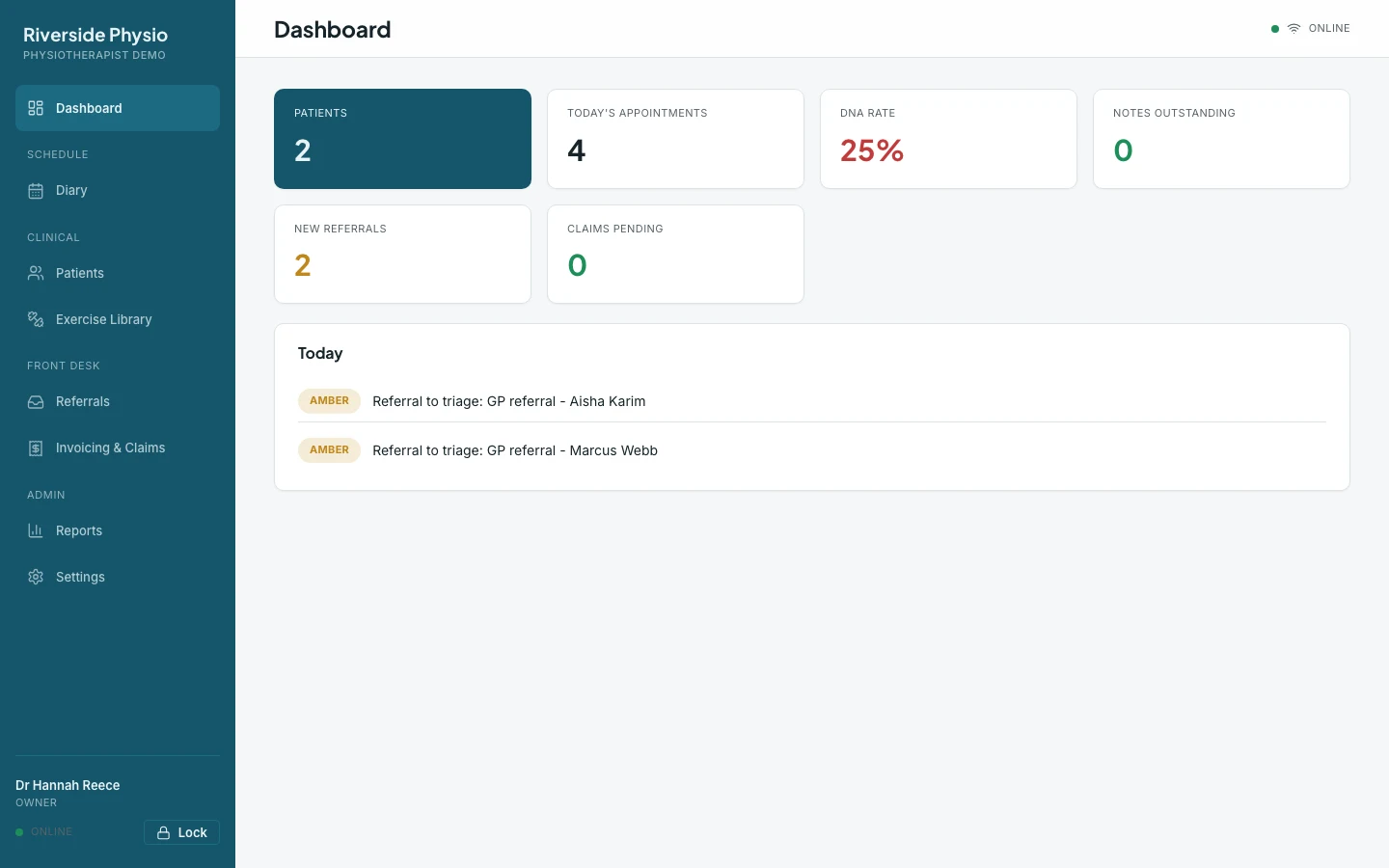
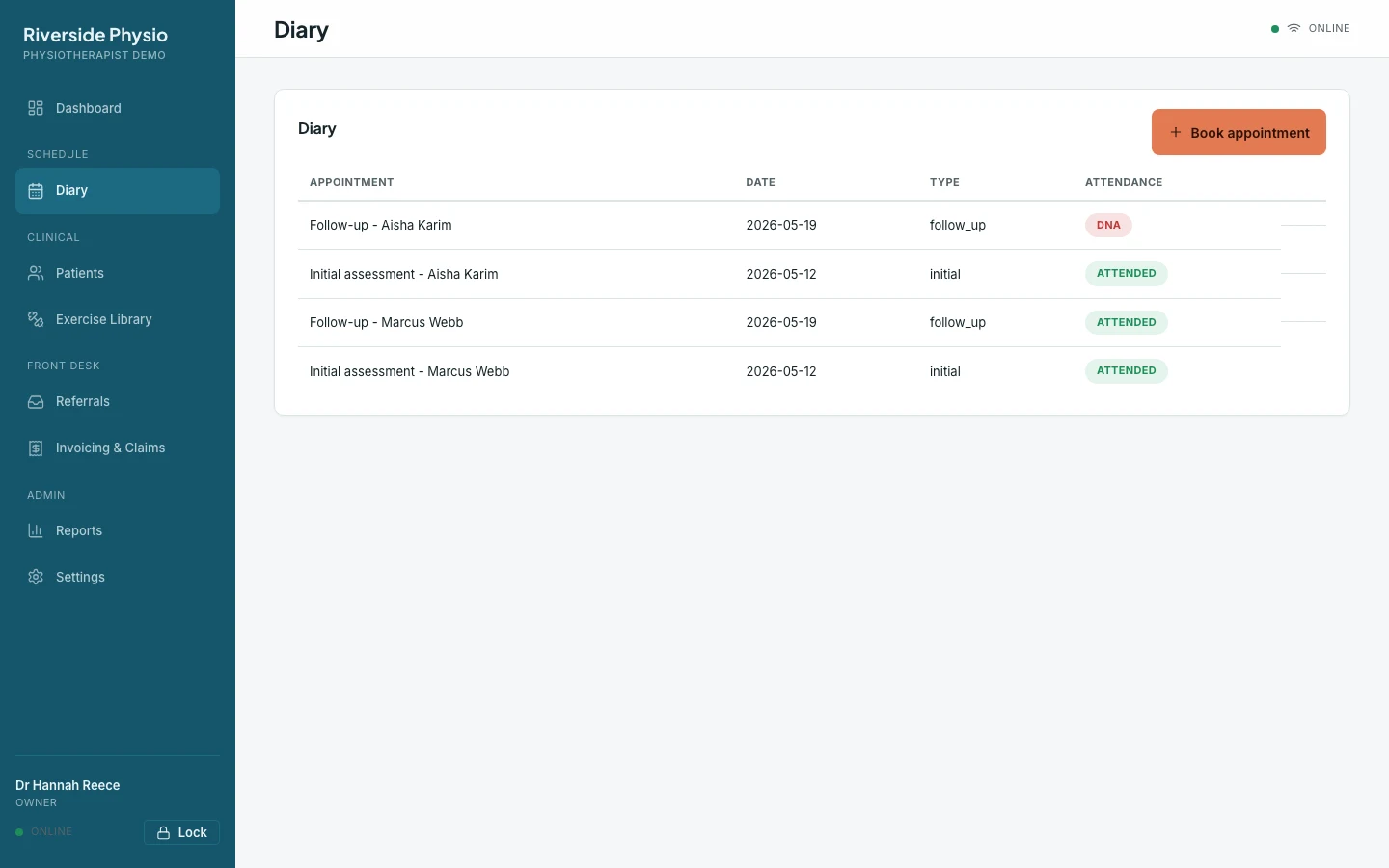
A simplified live demo. Choose a user to explore as, no login needed. Open full screen →
The UK physiotherapy practice management market includes a mix of international platforms popular with allied health clinics and UK-focused systems built for private practice billing realities. Named competitors that come up repeatedly for physios are Cliniko, TM3 and WriteUpp. Exercise prescription is often a separate subscription (Physitrack, Rehab My Patient). UK private medical insurance billing (Bupa, AXA Health, WPA and others) frequently requires Healthcode integration or workarounds. Here is what is available and what each one actually delivers.
| Provider | What They Offer | Pricing | Watch Out For |
|---|---|---|---|
| Cliniko | Cloud PMS with scheduling, clinical notes, invoicing, online booking and reporting. Strong international user base among allied health. UK clinics use it for physio and similar disciplines. No native Healthcode; third-party tools (e.g. Effra) or direct submission used for PMI claims. | Tiered by practitioners: ~$45/mo for 1, $95 for 2-5, up to $395 for 26-200 (USD, billed in local currency). 30-day trial. SMS extra. | Exercise prescription and full UK insurer billing are not native. Per-practitioner scaling adds cost as you grow. Data export for migration is possible but requires planning. |
| TM3 (Blue Zinc) | UK-developed cloud system with strong physiotherapy focus. Appointments, clinical notes, billing, online booking, payments (ClearAccept) and reporting. Built for UK private practice workflows. | Subscription-based, often quoted per user or site. Contact for current pricing; historically positioned as accessible for UK physio clinics. | Pricing and full feature access require direct quote. Exercise prescription typically handled via integration rather than core module. |
| PPS (Rushcliff) | UK private practice software with appointment scheduling, treatment notes (SOAP), client and insurance billing, online booking, KPI reports and auditing. Integrates with Rehab My Patient for exercise prescription. | From around £15-£60+/mo depending on package and users. Extended trials available via some associations (e.g. Physio First offers). | Interface can feel traditional compared to newer cloud platforms. Customisation is a strength but requires setup time. |
| WriteUpp | UK cloud PMS aimed at healthcare professionals including physiotherapists. Scheduling, clinical notes, invoicing, online booking, payments and direct Healthcode integration for major UK insurers (Bupa, AXA, WPA etc.). | Per-user model: Flex ~£19.95/mo, Solo ~£27.95/mo, Group from ~£45.95/mo for 2+ clinicians. Add-ons for online booking and video. Online calculator available. | Feature depth varies by plan tier. Good native UK billing but confirm current Healthcode coverage for your exact insurer mix before committing. |
| Jane | Cloud PMS with strong clinical charting, treatment plans, scheduling, billing and client portal. UK presence with support for Healthcode submission (beta/export flows documented). Popular for notes and workflow depth. | Plan-based with per-practitioner elements on higher tiers (e.g. group telehealth add-ons). Quote-based for full setup. UK-specific guidance available. | Primarily known in North America; UK billing and insurer features are available but may require configuration and testing against your exact PMI workflows. |
| Nookal | Cloud practice management with booking, notes, billing and reporting. Used by UK clinics alongside Australian base. Supports Healthcode for UK private healthcare billing in some configurations. | Per-practitioner subscription model. Contact for UK-specific quote; positioned competitively for multi-practitioner allied health. | UK-specific depth (insurer billing, exercise integration) varies; verify current Healthcode and exercise prescription capabilities for your needs. |
| Pabau | Cloud PMS/CRM with bookings, clinical records, invoicing, marketing tools and reporting. UK-based with Healthcode support for private medical insurance billing. | Per-location or subscription model; add-ons often required for full functionality. Quote-based. | Marketing/CRM strengths can come at the expense of deep clinical note or exercise prescription depth compared to pure PMS tools. Confirm UK billing flows. |
A clear pattern in the UK physio market is the separation of concerns. Core practice management (notes, booking, invoicing) is one subscription. Exercise prescription and home programme delivery is frequently another (Physitrack at £19.49 + VAT per practitioner per month or Rehab My Patient from around £11-20 per practitioner per month). UK PMI billing often requires either native Healthcode support or a third-party bridge, adding cost and another data touchpoint. Per-practitioner pricing means costs scale directly with headcount, which matters for clinics using associates, locums or growing teams.
Most of these platforms are perfectly usable. The question for an independent or growing clinic is whether the combination of per-user fees, separate exercise subscriptions, and variable UK insurer billing support actually matches how you run the business, or whether you end up maintaining workarounds alongside the "all-in-one" system.
The platforms listed above are functional products. They work. But they were designed for a generalised version of a physiotherapy clinic, and no two clinics are general.
A single-room sports injury clinic in a leisure centre operates differently from a multi-site MSK group with consultants, extended scope practitioners and a large self-pay base. An NHS-contracted First Contact Practitioner service has different reporting, coding and integration needs from a private clinic that also runs Pilates classes and corporate contracts. A clinic with heavy PMI volume (Bupa, AXA authorisations daily) needs different billing discipline from one that is almost entirely self-pay or GP-referred.
What typically happens is this: you adopt the software, go through implementation, and then discover it does not quite match how your clinic runs. The booking flow assumes a referral sequence your reception does not follow. The notes template forces fields that do not match your assessment style. Exercise prescription is a separate login and another monthly fee. Insurance claims require re-keying or a third-party bridge because Healthcode integration is partial. The DNA and utilisation reports track the metrics the vendor chose, not the ones your commissioners or your P&L actually need.
Then there is the control problem. When a vendor changes pricing or interface, you adapt or migrate. When they sunset a feature or change terms, you lose leverage. Your clinical records, the data your clinic has built over years, live on someone else's servers under someone else's terms. For a clinic that wants to stay independent, that dependency matters.
A bespoke system starts with your clinic. Not a product demo. Not a feature list designed for a general audience. Your actual daily workflow, from the first self-referral of the day to the last note and claim at close, including the edge cases (complex PMI authorisations, mixed NHS/private lists, Pilates classes, corporate contracts) that off-the-shelf software was never designed to handle.
We sit down with your clinical and administrative team and map exactly how your clinic operates. Then we build a system that matches it precisely. The result is software where every screen, every form, and every workflow reflects the way your people actually work.
Every system starts with your specific requirements. Here are examples of what your system could include:
Apply to become a physiotherapy design partner · · Replies within 24 hours
The physiotherapy software market is in the middle of a transition from legacy desktop systems to cloud-based platforms. Cloud solutions are growing because they support remote access for clinicians, automatic updates, and lower upfront infrastructure. Many UK physio clinics have moved or are moving.
But the way most vendors implement cloud hosting comes with trade-offs that are rarely discussed upfront.
When your practice management system is cloud-based and hosted by the vendor, your data lives on their servers. You access it through their application. If they experience downtime, your clinic stops. If they change their terms or pricing, you comply or migrate. If they are acquired, your clinical records transfer to the new owner whether you agreed to it or not.
A bespoke system gives you the benefits of cloud without the dependency. Your system is hosted on secure UK-based servers. Your data belongs to you. Every change is recorded in real time to a write-ahead log (WAL), so nothing is ever lost. You can also back up locally on a schedule for additional peace of mind. If you want to move providers, your data comes with you because it was always yours.
ESRE builds physiotherapy clinic systems for a one-off cost. No monthly subscription. No per-clinician fees. No price increases tied to your clinic growing or adding staff.
A physiotherapy clinic does not just pay for a practice management system. Most run several separate subscriptions, each covering a different part of the operation. For a typical single-site MSK clinic with 2-4 clinicians, the monthly spend commonly looks something like this once you include everything needed for UK private practice.
| System | Typical Monthly Cost | Examples |
|---|---|---|
| Practice management (PMS) | £15 to £80 per practitioner | Cliniko (tiered), WriteUpp (~£15/user+), TM3, PPS, Jane, Nookal, Pabau |
| Exercise prescription | £11 to £20 per practitioner | Physitrack (£19.49 + VAT), Rehab My Patient (from ~£11-20) |
| Insurance billing / Healthcode | 0.3% per claim or subscription + registration | Healthcode (direct or via PMS bridge); some PMS include or reduce the friction |
| Accounting | £25 to £45 total practice | Xero, QuickBooks, Sage |
| Total monthly cost (example 3-clinician clinic) | £150 to £400+ | |
| Five-year total | £9,000 to £24,000+ |
Each of these systems holds a different slice of the clinic's data. Patient contact and notes in the PMS. Exercise plans in Physitrack or Rehab My Patient. Claims and remittances in Healthcode or a bridge. Financial data in Xero. None of them share data without manual effort or fragile integrations that break when one vendor updates their API. Per-practitioner pricing also means costs rise every time you add an associate or locum.
| System Scope | Typical One-Off Cost | Replaces |
|---|---|---|
| Core: booking, clinical notes, treatment plans, basic invoicing, reporting | £10,000 to £18,000 | PMS subscription + workarounds for notes and reporting |
| Full: above plus exercise prescription, insurance billing (Healthcode flows), patient portal, advanced reporting (DNA, utilisation, revenue per clinician) | £18,000 to £35,000 | PMS + exercise subscription + billing friction + accounting workarounds |
| Multi-site: full system across 2 to 6 sites with centralised records and reporting | £30,000 to £65,000 | Per-site subscriptions multiplied across locations |
A clinic paying £300 per month across its tools spends £18,000 over five years and owns nothing. A bespoke system at £25,000 pays for itself in under three years, replaces every subscription, and belongs to the clinic permanently. After year three, every month is pure savings. The higher upfront cost is the real trade-off; the ownership and fit are the return.
Every system we build, the client owns all the code. There is no vendor lock-in. No proprietary platform you depend on. No API that disappears when a vendor changes direction or gets acquired.
This matters in physiotherapy software because the dominant platforms are often built for scale first and UK private practice billing second. When your notes, exercise plans and claims live in systems you do not control, the incentives are not aligned with your independence or your HCPC/CSP record-keeping duties. A bespoke system removes that conflict entirely.
What we build is not one screen. It is a connected data architecture from which multiple applications emerge. Patient data is entered once and appears wherever it is needed.
All of these surfaces draw from the same data. An exercise plan prescribed during a treatment is immediately visible in the patient's portal, in the follow-up booking logic, and in any reporting on adherence or outcomes. No syncing between separate systems.
We train you and your team to evolve the system using AI. Since December 2025, AI tools have reached the maturity to work reliably alongside people for maintaining and extending systems. We set up your AI to understand your specific codebase, with failsafe environments, version control, and automated backups.
Because Technology DNA already holds the data architecture, adding new functionality is straightforward. Need to add a corporate contract module with utilisation reporting? It draws from the same appointment and notes data. Want to add telehealth sessions with recorded exercise delivery? They connect to the existing patient records and plans. Adding a new outcome measure for a specific commissioner? It links to the clinical workflow. Technology DNA is the foundation. Everything after that is incremental, and much of it can be done in-house with the tools we provide.
See examples of what we build across different sectors.
Cliniko, TM3, WriteUpp, Jane and others charge monthly per practitioner or by tier. A bespoke clinical system that fits your workflow exactly, owned outright for a one-off build cost.
Audit trails, consent capture, retention logic aligned with the Records Management Code (8 years for adults), and the fields the CSP guidance and HCPC standards expect. Compliance is in the architecture, not a separate checklist.
Every clinical entry, exercise plan, claim and access event recorded and immutable. Rollback to any point. The evidence burden for HCPC, CSP, ICO and potential claims handled at the data layer.
Describe the assessment and treatment, the system structures it into your SOAP template, links the exercise plan, and records the entry with full audit. Not a third-party subscription. Built into the system itself.
A core physiotherapy clinic system (booking, notes, exercise prescription, basic billing and reporting) typically takes six to ten weeks from first conversation to live deployment. Systems with full Healthcode insurance billing flows, complex outcome measure exports, multi-site records, and data migration from Cliniko, TM3 or WriteUpp take ten to fourteen weeks.
Yes. We regularly import patient records, clinical histories, appointments, exercise plans where exportable, and financial data from the main UK platforms. The goal is a complete transition with no data loss and minimal disruption to your clinic operations.
HCPC standards of proficiency and the CSP record-keeping guidance are built into the system from the start. Clinical records include the fields and audit requirements expected: patient identification, assessment findings, treatments, consent, exercise plans, and full change history. Retention logic follows the NHS Records Management Code (8 years for adult records, to age 25/26 for children).
Yes. We build the authorisation capture, claim generation and remittance posting for the insurers you actually work with. Where you are a registered provider, electronic submission routes through Healthcode. The clinical record is the single source; claims and patient invoices are generated from it, not re-keyed.
Your system is cloud-hosted on secure UK-based servers. Your data belongs to you. Every change is recorded in real time to a write-ahead log (WAL), so nothing is ever lost. You can also back up locally on a schedule for additional peace of mind. If you ever want to move providers, your data and code come with you.
Yes. There is a live physiotherapy demo you can open now, without a login. Open it as owner, physio, receptionist, manager or patient and use a working system. It is free to try; a production build is a one-off project that you own.