What Shop Software Needs to Do
An independent shop runs on a simple trade cycle that never stops: stock comes in, stock sells, you reorder before you run out, and at the end of the day you reconcile the till. A box of crisps arrives from the wholesaler, sits on the shelf, gets scanned at the counter, and the moment it sells you are a little closer to needing another box. Good shop software follows that loop all the way round and keeps every record connected, so a sale at the till is also a change to your stock, your margin figures, and your reorder list at the same instant.
At minimum, a system for an independent shop needs to handle:
- Till and checkout that scans a barcode or lets you type, takes card or cash, prints a receipt, and reduces the stock count automatically with every sale
- Live stock control with automatic decrement on every sale, low-stock alerts, and expiry tracking for perishables so you stop finding out-of-date stock on the shelf
- Supplier ordering where the system proposes a purchase order from thresholds you set, and deliveries are scanned straight back in
- Reports that tell you something: margin per line, top sellers, non-movers (dead stock), busiest hours, waste and loss, and VAT by rate ready for your return
- A product catalogue you can fill with CSV bulk import and barcode lookup, not a thousand items keyed in by hand
- End-of-day cash reconciliation so the float, the takings and the card total all tie up before you lock up
- Offline-capable operation so the till keeps working when the broadband drops and syncs later
The more useful systems go further: a staff rota with hours and pay-owed tracking, a single view across more than one shop, and a website that sells from the same stock figures rather than a separate spreadsheet that drifts out of date by lunchtime.
Inside the live retail software demo
A simple demo for shops. Open it as staff and ring a sale with live stock update, or as owner and see the shrinkage report. It runs the shop floor to back office:
- EPOS till that updates stock in real time as items are sold.
- Live stock visible to staff and owner without separate spreadsheets.
- Supplier ordering generated from the same stock data.
- Shrinkage and crime tracking with reason codes and patterns over time.
- Card-fee reporting so the true cost of each payment type is visible.
We build your system around your shop and you own it outright. The build cost is upfront, but over two to three years you save significantly against subscription fees.
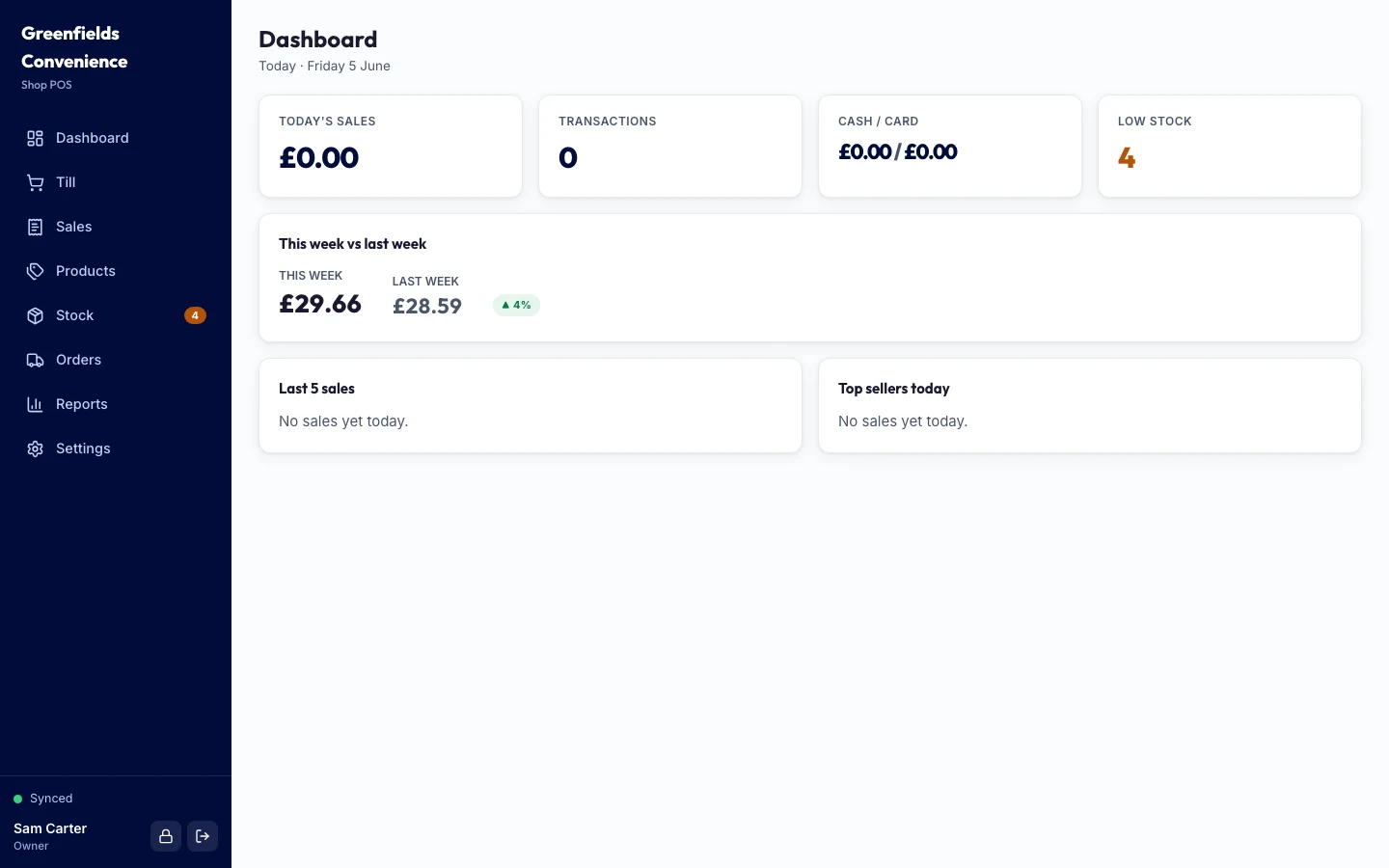
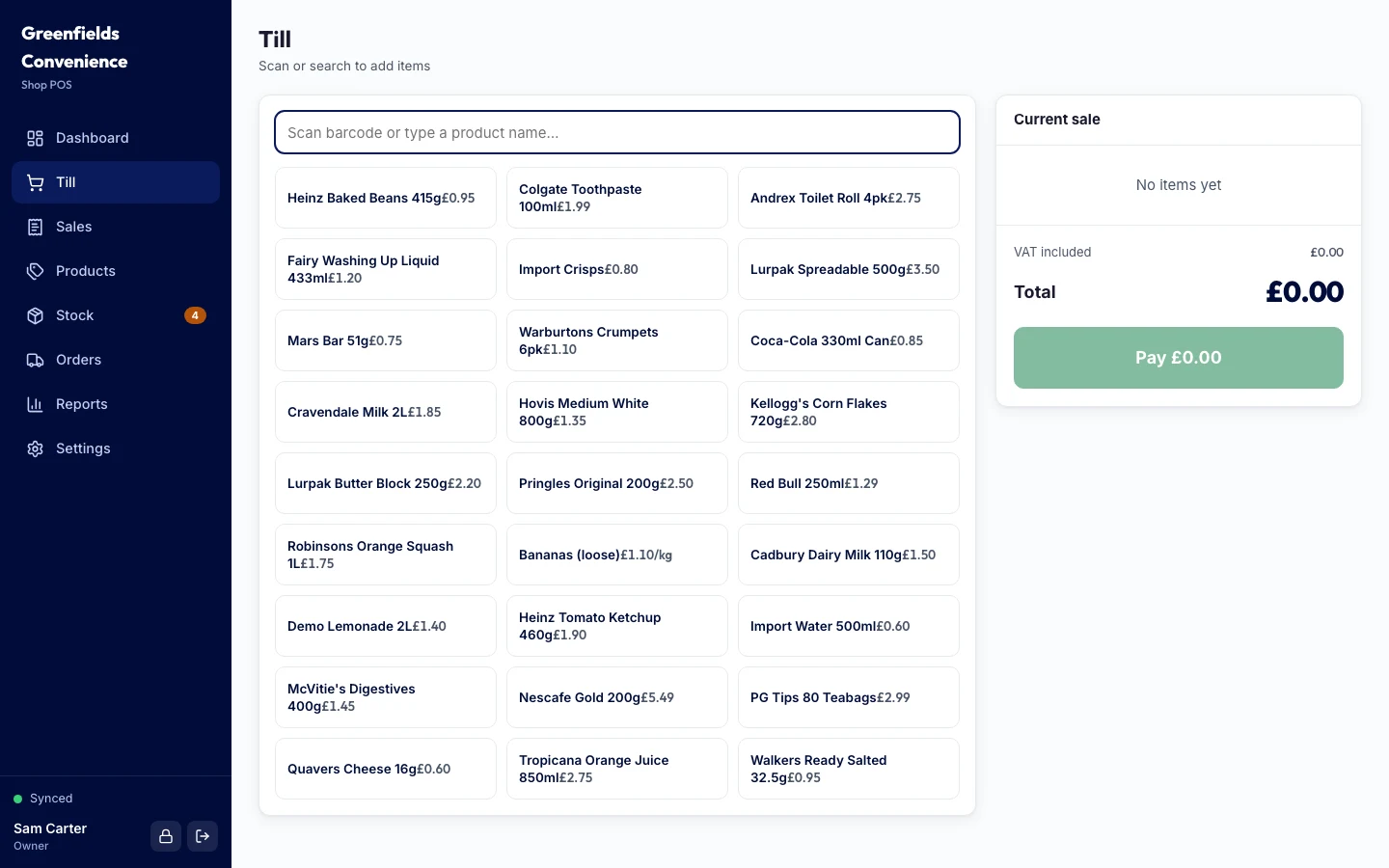
A simplified live demo. Choose a user to explore as, no login needed. Open full screen →
The Real Pressures on Independent Shops
The squeeze on an independent shop is not abstract. It shows up as two hard numbers every week: what walks out unpaid, and what it costs to keep the doors open and the tills staffed.
Retail crime and shrinkage
The scale of theft from convenience stores is now severe. The ACS Crime Report 2024/25 puts the cost of retail crime at £316m in a single year, off the back of 6.2m theft incidents (up from 5.6m), which works out at over 600 every hour. Retailers spent more than £265m on crime prevention in the same period. The ACS describes the combined effect as the equivalent of a 10p "crime tax" added to every transaction. That is money leaving an already thin margin before you have paid a single supplier.
A basic till cannot see any of this. It records what is paid for, not what is missing. A system with live stock, on the other hand, makes shrinkage visible: when the count says you should have forty of something and you have twenty-eight, the gap is in front of you, by line, by week, and often by the hours it tends to happen. You cannot stop everything, but you cannot manage what you cannot measure, and most shops currently cannot measure it at all.
Labour cost and owner hours
Wages are the other pressure, and they keep climbing. Under the UK Government's National Minimum Wage (Amendment) Regulations 2026, the National Living Wage rose to £12.71 per hour on 1 April 2026, a 4.1% increase from £12.21. For context, the ACS notes it was £11.44 in April 2024, itself a 9.8% jump that year. And the headline rate understates the real burden: the University of Stirling, working with the SGF in 2024, put the true, fully-loaded cost of employment at about £15.39 per hour once on-costs are included, and that figure predates the 2026 rise, so the real cost is now higher.
Owners absorb the difference with their own time and their own margin. According to the ACS, with the University of Stirling and SGF, 75% of convenience store owners and managers work 65 or more hours a week. The ACS also found that, to cope with rising wages, 53% of retailers cut investment and 47% simply took lower profits. A system that automates the manual steps, proposing the order, counting the stock, reconciling the till, and pulling the VAT figures together, gives the owner back some of the hours that 65-hour week is built from, and lets the staff time go on serving customers rather than counting shelves.
The Monthly Cost Myth
There is a common assumption that running a shop till means paying a software company every month forever. For shops, that assumption is often wrong, and the truth is more interesting. The convenience sector is not one market but several, and the right answer depends on which situation you are actually in. Here are the five you are likely to recognise.
Situation one: you run on no EPOS at all. Around half of convenience stores use no EPOS at all, on The Retail Data Partnership's estimate: a basic till, paper, or a spreadsheet. You pay nothing monthly, which is fine, but you are flying blind on stock, margin and shrinkage. What wins here is not a subscription. It is a system that gives you visibility while you keep your existing counter kit, owned outright so the saving is permanent.
Situation two: you own a perpetual-licence till. ICRTouch TouchPoint has been installed over 150,000 times in the UK on a perpetual licence with no monthly fee, according to ICRTouch, typically £1,000 to £2,500 for a single till paid once. If this is you, you already understand the value of owning rather than renting. The question is only whether your till talks to your stock, your ordering and your website, or sits on its own.
Situation three: you are on a subscription system. Epos Now advertises a system at £199 (reduced from £849), but it requires a support and payments subscription from £54 per month plus card processing, on a 12 to 36 month contract, according to Epos Now. This is the situation people picture when they assume "shop software means monthly". It is real, but it is a minority, and it is the one where owning instead pays back fastest.
Situation four: you took the free symbol-group EPOS. Over 16,000 UK shops trade under a symbol-group fascia such as Spar, Nisa, Premier, Costcutter, Londis, Best-one or Mace, according to The Grocer. Symbol groups give EPOS free or subsidised, tied to buying your stock from them; Nisa quotes its evolution EPOS as a £3,895 saving, per ShopMate and The Grocer. The till feels free, but it is paid for in your supply terms, and it ties your data to the group. What wins here is owning a system that is yours regardless of who you buy stock from.
Situation five: you pay per card sale instead. Square and Zettle charge around 1.75% on every card sale with no monthly software fee on the basic tier, on Square and Zettle (PayPal) pricing. There is no monthly invoice, so it feels free, but the cost is hidden in the percentage. We come back to exactly how much that adds up to below.
The Main EPOS Options in the UK Right Now
The UK shop EPOS market is a genuine mix of owned, subscription and free-but-tied models. Here is a comparison of the main options, what each offers, what it costs, and the model it runs on. The figures are from each provider as noted.
| Provider | What They Offer | Pricing | Model |
|---|---|---|---|
| ICRTouch | TouchPoint EPOS, installed over 150,000 times in the UK. Established till software sold through dealers, with stock and reporting add-ons. No monthly software fee on the core licence. | Typically £1,000 to £2,500 per till, paid once (ICRTouch). | Owned (perpetual licence) |
| Epos Now | Cloud EPOS with app marketplace, stock and reporting. Hardware advertised cheaply but the system needs an ongoing support and payments plan. | System £199 (from £849), then a support and payments subscription from £54/month plus card processing, on a 12 to 36 month contract (Epos Now). | Subscription |
| Square | Free basic POS app, card reader, simple stock and reports. No monthly software fee on the basic tier. Cost is in the card rate. | Around 1.75% per card sale, no monthly software fee on the basic tier (Square). | Subscription (per-sale) |
| Zettle (PayPal) | Free POS app and low-cost reader from PayPal, with basic stock and sales reporting. Similar shape to Square. | Around 1.75% per card sale, no monthly software fee on the basic tier (Zettle, PayPal). | Subscription (per-sale) |
| SumUp | Card reader and app aimed at small traders. A lower-percentage plan is available for a monthly fee, which can suit higher card volumes. | 0.99% plan: 0.99% plus £19/month (SumUp). | Subscription (per-sale + fee) |
| Symbol-group EPOS | EPOS provided by the symbol group (Spar, Nisa, Premier, Costcutter, Londis, Best-one, Mace) to over 16,000 fascia shops. Tied to buying stock from the group. | Free or subsidised; Nisa quotes its evolution EPOS as a £3,895 saving (ShopMate / Nisa, The Grocer). | Free but tied |
| ShopMate (The Retail Data Partnership) | EPOS aimed at independent convenience retailers, with stock and price-file support. Sold outright rather than on a heavy monthly plan. | Around £999 (The Retail Data Partnership). | Largely owned |
These are all serious products from companies that know the trade. The point is not that any of them is bad. It is that none of them is yours in the way a bespoke system is: the owned tills do not connect the whole loop together, the subscription and per-sale options keep taking money for as long as you trade, and the free symbol-group till is paid for in your supply terms and ties your data to the group.
Where Off-the-Shelf Falls Short
A lot of small-business EPOS is built to serve everyone, which means it is built for no one in particular. The same product that runs a hair salon, a coffee bar and a clothing boutique is sold to a convenience store, and a convenience store is none of those things. A shop has perishables that expire, a wholesaler price file that changes weekly, VAT split across rates on a single basket, age-restricted lines, and a stockroom full of multipacks that break down into singles on the shelf. Generic systems handle some of that and fudge the rest.
What usually happens next is workarounds. A spreadsheet on the side for the lines the EPOS does not track properly. A paper list by the stockroom door for reordering because the system's ordering does not match how your reps actually work. A separate note of waste and out-of-date stock that never makes it into a report. You end up running the software alongside the systems it was supposed to replace.
The deeper problem is ownership of the data. On a subscription or per-sale platform, your sales history, your stock figures, your customer information and your supplier data live on the vendor's servers under the vendor's terms. If you stop paying, in many cases you lose easy access to your own trading record. Even where you can export it, the format is whatever the vendor allows, and the website (if you have one) is usually a separate product on separate billing that does not share a single figure with the till. The data is not really yours, and the parts of your business that should be one joined-up picture stay in separate boxes.
Deep Dives
What a Bespoke Retail System Looks Like
A bespoke system starts with your shop, not a product demo. We sit down with you and map exactly how you trade: which suppliers, which price files, which perishables, how you reorder, how you cash up. Then we build a system that matches it. The best way to show what that means is to describe what the ESRE shop demo already does, because none of this is hypothetical.
- Till and checkout. Scan or type, take card via a Revolut Terminal or cash, print a receipt, and the stock count drops automatically on every sale.
- Live stock. Automatic decrement on every sale, low-stock alerts, and expiry tracking for perishables so you catch out-of-date lines before the customer does.
- Supplier ordering. The system proposes purchase orders from thresholds you set, and deliveries are scanned straight in against the order.
- Reports that earn their place. Margin per line, top sellers, non-movers (dead stock), busiest hours, waste and loss, and VAT by rate.
- A real product catalogue. CSV bulk import, barcode lookup via Open Food Facts, and phone-camera scanning, so nobody keys in a thousand products by hand.
- Phone scanning. Every smartphone becomes a scanner for deliveries, shelf work and stocktakes. It is a progressive web app, so there is no app-store download.
- End-of-day reconciliation. Cash, card and float tie up before you lock the door, and the till is offline-capable, so it keeps working if the internet drops and syncs later.
- Keep your kit. Keep the existing screen, USB barcode scanner, receipt printer and cash drawer. Only the card reader is swapped for a Revolut Terminal (about £169 plus VAT).
- Bolt-ons most generic EPOS does not do well. A staff rota with hours and pay-owed tracking, and a single multi-site HQ view across more than one shop.
- Your data, fully yours. Full data ownership and export, data on secure UK servers, and rollback to any second via a write-ahead log.
Every screen, every form and every report reflects how your shop actually works, because it was built around your shop and nobody else's.
Connect with us about retail software · · Replies within 24 hours
The Cost Comparison
ESRE builds shop systems for a one-off cost. No monthly software fee. No per-sale percentage on the software. You pay once and you own the system. To see why that matters, it helps to add up what the subscription-and-tool route actually costs over time, then compare it to a one-off owned build.
A typical subscription and tool stack
Few shops pay for just one thing. The card fees alone are the quiet one. The figures below are illustrative, based on a shop doing about £15,000 a month in card sales, using each provider's published rates. The card-processing monthly and annual costs are ESRE framework calculations from each provider's pricing.
| Line item | Rate | Illustrative monthly | Illustrative annual |
|---|---|---|---|
| Card processing – Square | 1.75% | ~£262.50 | ~£3,150 |
| Card processing – Zettle | 1.75% | ~£262.50 | ~£3,150 |
| Card processing – SumUp (0.99% plan) | 0.99% + £19/month | ~£167.50 | ~£2,010 |
| Card processing – Stripe Terminal | 1.4% + 20p | ~£240 | ~£2,880 |
| Card processing – Revolut | 0.8% + 2p (+ £10/month account) | ~£130 | ~£1,560 |
| EPOS subscription (e.g. Epos Now support and payments) | from £54/month | from £54 | from ~£648 |
The card line is the one most owners never add up. On Square or Zettle at around 1.75%, a shop taking £15,000 a month in card sales pays roughly £3,150 a year. On Revolut at around 0.8%, the same shop pays roughly £1,560 a year. Moving from about 1.75% to 0.8% saves over £1,500 a year on transaction fees alone, on ESRE framework figures, and a system you own lets you choose the cheapest processor rather than being tied to one. Put the card saving and a dropped EPOS subscription together over five years and the figure runs well into the thousands.
What a bespoke system costs
| System Scope | Typical One-Off Cost | Replaces |
|---|---|---|
| Core build: till, live stock, supplier ordering, reports, product catalogue, reconciliation | ~£2,000 to £3,000 | EPOS subscription, separate stock and ordering tools, the side spreadsheets |
| Larger scope: above plus a staff rota and an integrated website on the same data (illustrative) | More than the core (illustrative) | EPOS subscription + a separate website product + marketing tools |
| Multi-site: full system across more than one shop with a single HQ view (illustrative) | ~£2,000 to £3,000 vs a second premium dealer till at £5,000 to £7,000 | A second per-site subscription, or a second premium dealer till |
A bespoke owned shop system starts around £2,000 to £3,000 as a one-off for a core build, owned outright with no monthly software fee, on ESRE's internal offer; larger scopes such as multi-site, a staff rota or an integrated website cost more. For an owner opening a second shop, ESRE's internal research puts a bespoke multi-site system at roughly £2,000 to £3,000, materially cheaper than buying a second premium dealer till, which can be £5,000 to £7,000. The card-fee saving alone (over £1,500 a year for a shop doing £15,000 a month, on ESRE framework figures) can cover a core build inside two years, after which the saving is simply yours.
Your Code, Your Control
Every system we build, the shop owns all the code. There is no monthly software fee, no licence fees, and no lock-in. No proprietary platform you depend on. No vendor who can switch you off, change the terms, or quietly take a cut of every card sale. If the relationship with ESRE ended tomorrow, your system would keep running exactly as it does today.
Your sales history, stock figures, supplier data and customer records live on secure UK servers under your control, with full export at any time. And it is serious from day one: a complete audit trail, automated backups, and rollback to any second via a write-ahead log, so nothing is ever lost. If something we built turns out to be faulty, we fix it at no cost, with no time limit. Early clients get free permanent hosting for a limited time.
One data source, many applications
What we build is not one screen bolted to a till. It is a connected data architecture from which several applications emerge, all drawing on the same single source of truth. A product is entered once and appears wherever it is needed: at the till, on the stock screen, in the ordering list, in the reports, and on the website if you want one.
No subscription, no licence fees, no per-sale cut on the software, no lock-in. One system replaces the till, stock, ordering, reports and your website. If we vanished tomorrow it keeps running.
Noticeably fast, delivered in weeks rather than months, and built to grow with the shop. Keep your existing screen, scanner, printer and cash drawer; only the card reader changes.
Product, price, stock, supplier and sales history in one place. The website can be part of the same system, selling from the same live figures, not a spreadsheet that drifts out of date.
Complete audit trail, automated backups, UK data servers, and rollback to any second via a write-ahead log. If something we built is faulty, we fix it at no cost with no time limit.
Evolve it in plain English
We train you and your team to evolve the system using AI. Since December 2025, AI tools have reached the maturity to work reliably alongside people for maintaining and extending systems, and to do it in plain English. We set up your AI to understand your specific codebase, with failsafe environments, version control, and automated backups, so changes are safe to try and easy to undo. Want to add a deli counter with weight-based pricing, or a loyalty scheme, or a delivery round? Because the data already exists, that connects to it rather than starting again. The first build creates the foundation; everything after is incremental, and much of it can be done in-house with the tools we provide.
Why businesses choose bespoke See what we're building right nowGetting Started and Data Migration
Switching systems is the part most shopkeepers dread, and it is exactly where the off-the-shelf vendors rely on you giving up. Years of product lines, prices, suppliers and barcodes sitting in whatever you use now. We handle the migration as a standard part of every build.
We extract your data from wherever it lives, a spreadsheet, an old till, or a cloud platform, clean it, restructure it, and import it into your new system. Products, prices, suppliers, barcodes and any sales history come across. On top of that, the product catalogue supports CSV bulk import and barcode lookup via Open Food Facts, with phone-camera scanning, so even the items that were never recorded properly can be built up quickly rather than typed in one by one.
If your current setup makes export difficult, we work around it. We have pulled data out of spreadsheets, ageing tills, and cloud platforms that were never designed to let it out. The goal is always a clean switch with nothing left behind and no day where the shop cannot trade.
Frequently Asked Questions
How much does retail software cost for an independent UK shop?
It depends on the model. A perpetual-licence till such as ICRTouch TouchPoint is typically £1,000 to £2,500 paid once per till, according to ICRTouch. Subscription systems like Epos Now advertise hardware from £199 but require a support and payments plan from £54 per month on a 12 to 36 month contract. Square and Zettle charge around 1.75% per card sale with no monthly software fee on the basic tier. A bespoke owned system from ESRE Media starts around £2,000 to £3,000 as a one-off for a core build, owned outright with no monthly software fee.
Do I really need EPOS if I run a small shop on a basic till?
Around half of convenience stores use no EPOS at all, according to The Retail Data Partnership, so a basic till is common and not wrong. The question is what you cannot see without one: live stock levels, margin per line, dead stock, busiest hours, waste, and VAT by rate. A bespoke owned system gives you that visibility while letting you keep your existing screen, USB barcode scanner, receipt printer and cash drawer.
Will a bespoke retail system lower my card processing fees?
Yes, by letting you choose the cheapest processor instead of being tied to one. Square and Zettle charge around 1.75% per card sale. Revolut charges around 0.8% plus 2p. On a shop taking about £15,000 a month in card sales, moving from about 1.75% to 0.8% saves over £1,500 a year on transaction fees alone, on ESRE framework figures. The ESRE shop demo runs card payments through a Revolut Terminal, which is about £169 plus VAT as a one-off.
What can a bespoke shop system actually do?
The ESRE shop demo already handles till and checkout, live stock with automatic decrement on every sale, low-stock alerts and expiry tracking, supplier ordering with proposed purchase orders, reports on margin, top sellers, dead stock, busiest hours, waste and VAT by rate, a product catalogue with CSV bulk import and barcode lookup via Open Food Facts, phone-camera scanning so every smartphone becomes a scanner, end-of-day cash reconciliation, offline-capable operation, a staff rota, and a single multi-site view.
Can I migrate from a spreadsheet, an old till or a cloud platform?
Yes. We handle data migration as a standard part of every build. Your product list, prices, suppliers, barcodes and any sales history are extracted from a spreadsheet, an existing till or a cloud platform, cleaned, and imported into the new system. The product catalogue also supports CSV bulk import and barcode lookup, so nobody keys in a thousand products by hand. Nothing gets left behind.
Where is the system hosted and do I own my data?
Your system is hosted on secure UK-based servers and the data belongs to you, with full export at any time. Every change is recorded in real time to a write-ahead log, so you can roll back to any second and nothing is lost. Backups are automated. Early clients get free permanent hosting for a limited time, and if something we built is faulty we fix it at no cost with no time limit.
Can I try the retail software before committing?
Yes. There is a live retail demo you can open now, without a login. Open it as owner or shop staff and use a working system. It is free to try; a production build is a one-off project that you own.
Sources and further reading
- Payment Systems Regulator, PSR
- VAT registration, HM Revenue & Customs
- Making Tax Digital for Income Tax, GOV.UK