What Recruitment Software Needs to Do
A recruitment agency runs on relationships, data, and speed. Every day, consultants are sourcing candidates, screening CVs, scheduling interviews, managing client accounts, tracking placements, and chasing invoices. The right recruitment agency software determines whether consultants spend their time recruiting or doing admin. At the core of any modern system is an applicant tracking system that manages candidates through every stage of the hiring pipeline.
At minimum, recruitment agency software needs to cover:
- Applicant tracking (ATS) to manage candidates through the pipeline from application to placement, with configurable stages that match your actual process
- Recruitment CRM for managing client relationships, business development activity, job orders, and account history across your team
- Candidate database with CV parsing, search, tagging, and the ability to build talent pools segmented by skill, location, sector, and availability
- Job board posting so your system can post vacancies directly to Reed, Totaljobs, CV-Library, Indeed, and LinkedIn from one place, and pull applications back in automatically
- Interview scheduling with calendar management, automated confirmations, and reminders for candidates, clients, and consultants
- Compliance and right-to-work checks including document collection, expiry tracking, and audit trails for IR35, AWR, and GDPR
- Reporting and analytics covering KPIs like time-to-fill, source effectiveness, consultant activity, margin analysis, and pipeline forecasting
Agencies placing temporary workers also need timesheet management, shift scheduling, payroll processing, and contractor self-service portals. Agencies working across multiple sectors often need configurable workflows per division, since placing an IT contractor is a different process from placing a care worker.
The UK recruitment market generates approximately £24 billion in annual revenue. 70% of recruiters use technology daily. The tools they use directly affect how many placements they make and how much margin they retain.
Inside the live recruitment software demo
A simple demo for recruitment agencies. Open it as a consultant and move a candidate through the pipeline, or as the candidate and see what the client side shows. It runs the full agency workflow:
- ATS and CRM pipeline with one record for the job and the people attached to it.
- Job board integration so vacancies publish without duplicate entry.
- Agency compliance (right to work, references) captured at intake and carried through.
- Payroll and back-office fed from the same placement data.
We build your system around your agency and you own it outright. The build cost is upfront, but over two to three years you save significantly against subscription fees.
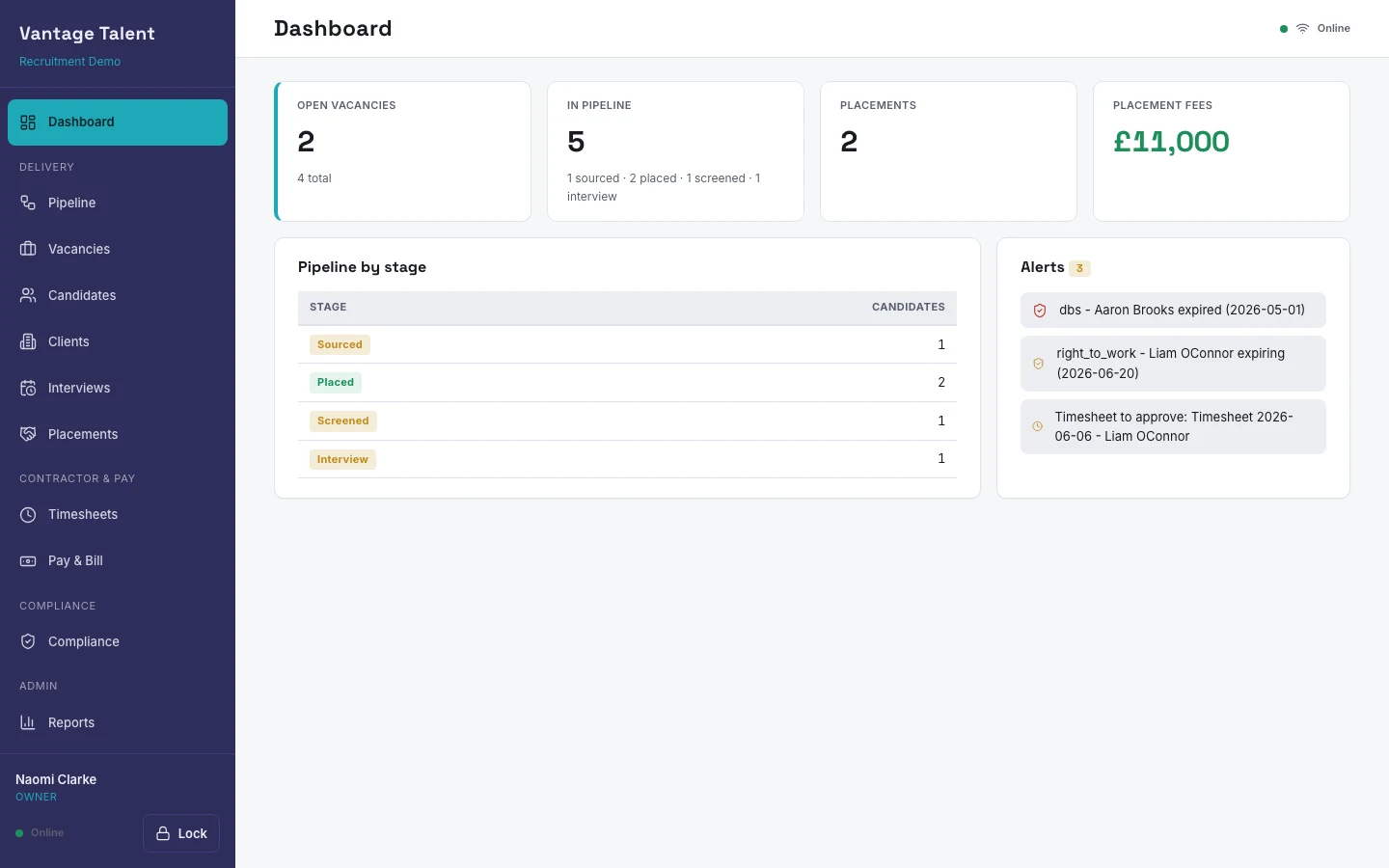
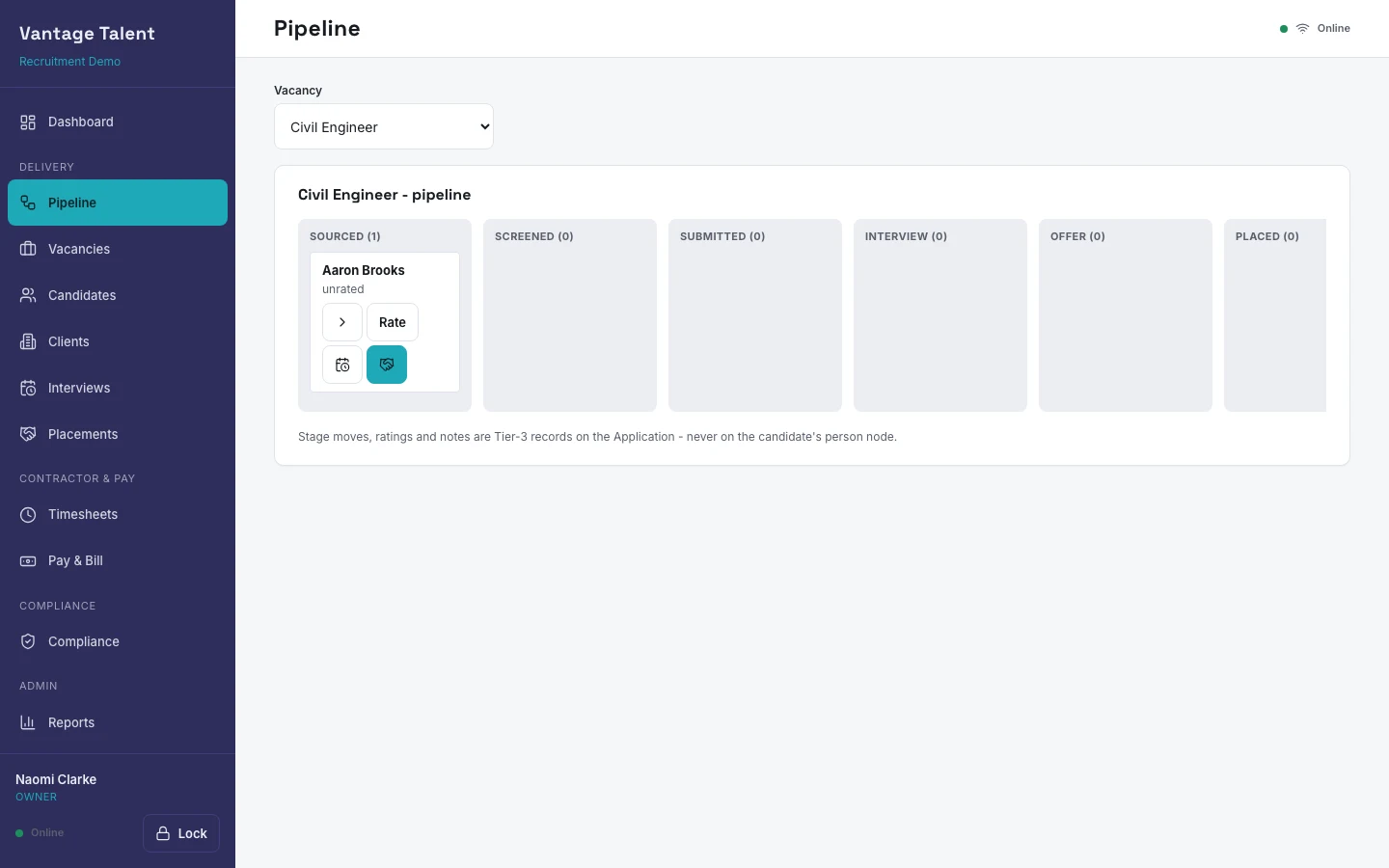
A simplified live demo. Choose a user to explore as, no login needed. Open full screen →
The Main Competitors in the UK Right Now
The UK recruitment software market is dominated by a handful of established platforms. Here is a direct comparison of what each one offers, what it costs, and where it fits.
| Provider | What They Offer | Pricing | Best For |
|---|---|---|---|
| Bullhorn | The market leader globally and in the UK. Full ATS, CRM, automation, and analytics suite. Extensive marketplace of add-ons. Powerful but complex. Users report a steep learning curve, dated interface, and aggressive price increases on contract renewal. | From ~£80/user/month. Enterprise pricing not disclosed. Multi-year contracts typical. Expect 15-20% increases at renewal. | Mid-to-large agencies with 20+ consultants who can absorb implementation costs and complexity. |
| Vincere (Access) | Combined ATS and CRM built specifically for recruitment agencies. Now owned by The Access Group. Clean interface. Strong automation. AI features available as paid add-ons from £25/agency/month. Good analytics. | From £85/user/month. Annual commitment required. 1, 2, or 3-year contracts with discounts for longer terms. | Growing agencies that want a modern alternative to Bullhorn with less complexity. |
| JobAdder | ATS and CRM with a clean, modern design. Strong job board integrations. Good mobile experience. AI features in higher tiers. Australian-founded, now well-established in the UK market. | From ~£130/user/month. Tiered plans (Lite, Essential, Pro). Contact for quote. | Agencies prioritising usability and job board management. Less suited to complex temp/contract workflows. |
| Zoho Recruit | Part of the Zoho ecosystem. ATS with candidate sourcing, resume parsing, and AI matching. Free tier available for very small operations. Good value at lower tiers but lacks the depth of agency-specific platforms. | Free (1 active job). Standard: ~£20/user/month. Professional: ~£40/user/month. Enterprise: ~£60/user/month. Billed annually. | Small agencies or in-house teams on a tight budget who can live with generic workflows. |
| Access Recruitment CRM | Long-established UK platform. Used by over 40% of the UK's top 500 agencies. Solid CRM and candidate management. Now being folded into the broader Access Group product suite alongside Vincere. | Not publicly disclosed. Contact for quote. Subscription-based. | Established UK agencies already within the Access Group ecosystem. |
| Firefish | UK-built recruitment CRM with marketing automation, candidate engagement tools, and a focus on inbound recruitment. Simpler feature set than Bullhorn or Vincere but well-designed for its scope. | From £58/user/month (annual billing). £65/user/month on monthly billing. | Small to mid-sized UK agencies that value simplicity and candidate marketing. |
Every platform listed above is subscription-based. You pay per user, per month, indefinitely. An agency with 10 consultants paying £85 per user per month spends £10,200 per year. Over five years, that is £51,000, and you still own nothing. If you cancel, you lose access to the system and may face difficulties extracting your data.
Where Off-the-Shelf Recruitment Software Falls Short
The platforms above are competent products. Bullhorn dominates for a reason. Vincere is well-designed. Zoho Recruit is good value at the lower end. But they all share the same fundamental limitation: they were built for a generalised version of a recruitment agency. Your agency is not general.
A permanent placement agency in financial services operates completely differently from a temporary staffing agency in healthcare. An executive search firm has different pipeline stages, different compliance requirements, and different client reporting expectations from a high-volume industrial recruiter. A multi-brand agency running three divisions from one office needs workflows that no off-the-shelf platform was designed to accommodate.
Here is what happens in practice. You adopt Bullhorn or Vincere. Your consultants start using it. Within weeks, you discover that the pipeline stages do not match your process. The compliance workflows do not cover your sector's specific requirements. The reporting does not show the metrics your management team actually tracks. The client portal does not present information the way your clients expect it.
Within six months, you are running several systems alongside the platform that was supposed to consolidate everything. Your consultants are entering data in multiple places. Your reporting is incomplete because the information is scattered. You are paying full subscription fees for software you are only partially using.
The connectivity problem
Off-the-shelf platforms offer connections through marketplaces and APIs. In theory, you can connect your recruitment software to your accounting system, your job boards, your background checking provider, and your payroll platform. In practice, these connections are limited to what the vendor has built or approved. If you need something that does not exist in their marketplace, you are stuck. If the vendor deprecates an API, your connection breaks and you wait for them to fix it.
The data ownership problem
Your candidate database is the most valuable asset your agency owns. Under GDPR, you are the data controller. But when that data lives inside Bullhorn's infrastructure or Vincere's cloud, your practical control is limited. Exporting data in a usable format is often difficult. Migrating to another platform is painful by design. The switching cost is the vendor's best retention tool.
Deep Dives
What a Bespoke Recruitment System Looks Like
A bespoke recruitment system starts with your agency. Not a product demo. Not a template. Your actual daily workflow, from job intake to candidate sourcing to interview coordination to placement to invoice.
We sit down with your consultants, your managers, and your compliance team. We map how your agency operates right now, what works, what does not work, and what you wish your current software could do but cannot. Then we build a system that matches it precisely.
What we can build for recruitment agencies
Every system starts with your specific requirements. Here are examples of what your system could include:
- An ATS that matches your pipeline. Your stages, your statuses, your automation triggers. If permanent placements follow a five-stage process and contract roles follow a seven-stage process, the system handles both natively. No workarounds, no forced standardisation.
- A CRM built for how you sell. Client accounts, contact history, business development tracking, and job order management structured around your actual sales process. If your consultants work 360-degree desks, the system reflects that. If you split business development and delivery, it reflects that instead.
- Candidate management tailored to your sectors. Custom fields, tagging structures, and search logic designed for the specific information that matters in your market. A healthcare recruiter needs different candidate attributes from a tech recruiter. The system captures exactly what your consultants need to make fast, accurate matches.
- Job board posting built into your system. Your system can post directly to Reed, Totaljobs, CV-Library, Indeed, LinkedIn, and any specialist boards you use. Multi-posting with per-board customisation. Application parsing that feeds directly into your pipeline with your categorisation rules applied automatically.
- Compliance built into the workflow. Right-to-work checks, reference collection, DBS tracking, IR35 assessments, AWR monitoring. Each sector has different compliance requirements. The system enforces yours, not a generic set. Document expiry alerts, audit trails, and GDPR-compliant data retention policies are embedded, not bolted on.
- Reporting that answers your questions. Time-to-fill by sector. Source effectiveness by channel. Consultant activity and conversion rates. Margin analysis by client, by division, by consultant. Pipeline forecasting based on your actual historical conversion data. The metrics you track, presented the way you want to see them.
- Temp and contractor management (if applicable). Timesheet capture, shift scheduling, availability management, holiday tracking, payroll processing, and contractor self-service portals. Configured for your pay and charge rate structures, your margin rules, and your invoicing cycles.
Connect with us about recruitment software · · Replies within 24 hours
What It Costs
ESRE builds recruitment systems for a one-off cost. No per-user subscription. No annual price increases. No multi-year contracts. You pay once and you own the system.
Common subscription costs in recruitment
Recruitment agencies rarely pay for just one platform. The CRM/ATS is the headline cost, but most agencies also pay for back-office tools, job board credits, compliance checking, and communication platforms. For a 10-consultant agency, the monthly spend commonly looks something like this.
| System | Typical Monthly Cost (10 users) | Examples |
|---|---|---|
| CRM / ATS | £600 to £1,200 | Bullhorn (£80-120/user), Vincere (£69-85/user), JobAdder, Firefish |
| Back office / pay and bill (temp agencies) | £200 to £500 | ETZ, Evertime, Finity, or Bullhorn Back Office (additional) |
| Job board multi-posting | £100 to £300 | Broadbean, LogicMelon, or direct credits |
| Compliance / referencing | £50 to £150 | Hireright, Sterling, or per-check fees |
| Email / marketing automation | £30 to £100 | Mailchimp, HubSpot, or CRM add-on |
| Total monthly cost | £980 to £2,250 | |
| Five-year total | £58,800 to £135,000 |
For temp and contract agencies, the back-office cost alone can exceed the CRM cost. And none of these systems share data cleanly. Placement details entered in the CRM are re-keyed into the back office. Compliance documents uploaded to the referencing tool are invisible to the CRM. The "integrated" agency is actually four or five disconnected subscriptions with manual data transfer between them.
What a bespoke system costs
| System Scope | Typical One-Off Cost | Replaces |
|---|---|---|
| Core: ATS, CRM, candidate database, reporting, job board posting | £10,000 to £20,000 | CRM/ATS + multi-posting subscriptions |
| Full: above plus compliance, analytics, client portal, marketing automation | £20,000 to £40,000 | CRM + compliance + marketing subscriptions |
| Enterprise: full system with temp pay-and-bill, multi-branch, contractor portal | £35,000 to £70,000 | All five subscription categories above |
A 10-consultant agency paying £1,200 per month across its tools spends £72,000 over five years and owns nothing. A bespoke system at £30,000 pays for itself in under three years, replaces every subscription, and belongs to the agency permanently. For temp agencies with back-office costs on top, the break-even point is even faster.
Your Code, Your Control
Every system we build, the client owns all the code. There is no vendor lock-in. No proprietary platform you depend on. No API that gets deprecated when a vendor decides to pivot. No 20% price increase at renewal because you are too embedded to leave.
Your candidate database, the most valuable commercial asset your agency holds, lives on infrastructure you control. You decide where the data sits, who can access it, and how long it is retained. Your GDPR compliance is genuine, not dependent on a third party's policies.
One data source, multiple applications
What we build is not one screen. It is a connected data architecture from which multiple applications emerge. Candidate and client data is entered once and appears wherever it is needed.
- A consultant workspace with pipeline view, candidate search, activity tracking, and one-click job posting
- A client portal where hiring managers view shortlists, provide feedback, and track progress without email chains
- A candidate portal for document uploads, availability updates, and timesheet submission
- A compliance dashboard showing right-to-work status, IR35 determinations, AWR milestones, and document expiry dates across all placements
- Management reporting with real-time margins, consultant performance, and pipeline forecasting
All of these surfaces draw from the same data. A placement created by a consultant is immediately visible to the compliance team, the back office, the client portal, and the management dashboard. No syncing. No re-entry.
Building on top of what already exists
We train you and your team to evolve the system using AI. Since December 2025, AI tools have reached the maturity to work reliably alongside people for maintaining and extending systems. We set up your AI to understand your specific codebase, with failsafe environments, version control, and automated backups.
Because Technology DNA already holds the data architecture, adding new functionality is straightforward. Expanding into a new sector that needs different compliance checks? The check connects to the same candidate and placement records. Adding a contractor self-service portal for timesheets? It draws from the same placement data. Building a business development dashboard that did not exist at launch? All the data it needs is already in the system. Technology DNA is the foundation. Everything after that is incremental.
See examples of what we build across different sectors.
Bullhorn, Vincere, and JobAdder all charge per user, per month. A bespoke ATS and CRM built for your desk and your sector, for a one-off cost you own outright.
Temp, contract, executive search, white-collar or blue-collar. The system is built around your process, not a generic one you adapt with workarounds.
Your system posts directly to the boards you actually use. No per-board subscription layered on top. No middleware to maintain when a platform updates its API.
Automated screening, candidate scoring, job brief generation. Built to work with AI trained on your own placements, not a third-party service storing your data on their servers.
Frequently Asked Questions
How much does recruitment software cost in the UK?
Subscription-based recruitment platforms in the UK typically charge £58 to £130+ per user per month. Bullhorn starts from around £80 per user per month. Vincere starts at £85 per user per month. Zoho Recruit ranges from free to £60 per user per month. For a 10-person agency, expect to pay £7,000 to £15,000+ per year on subscriptions alone. A bespoke system from ESRE Media costs a one-off fee based on your requirements, with no per-user subscription.
Can you migrate data from Bullhorn, Vincere, or another platform?
Yes. We regularly migrate candidate databases, client records, placement history, and compliance documentation from existing recruitment platforms. The process involves mapping your existing data structure, cleaning and deduplicating records, and importing everything into your new system. We handle the technical work. Your consultants see a clean, familiar dataset from day one.
How long does it take to build?
A core recruitment system with ATS, CRM, and candidate management typically takes six to ten weeks from first conversation to live deployment. More complex systems with temp management, multi-branch operations, advanced analytics, and extensive job board connections take ten to sixteen weeks. We deploy in phases so your team can start using core features while we build out the rest.
Can the system post to job boards?
Yes. We can build job board posting directly into your system, covering all major UK boards including Reed, Totaljobs, CV-Library, Indeed, and LinkedIn, as well as specialist boards in sectors like healthcare, education, and technology. Unlike marketplace-dependent platforms where you rely on a vendor to maintain connections, your system handles this natively.
Where is the system hosted?
Your system is cloud-hosted on secure UK-based servers. Your data belongs to you. Every change is recorded in real time to a write-ahead log (WAL), so nothing is ever lost. You can also back up locally on a schedule for additional peace of mind.
Can I try the recruitment software before committing?
Yes. There is a live recruitment demo you can open now, without a login. Open it as owner, consultant, compliance officer, payroll clerk, candidate or client and use a working system. It is free to try; a production build is a one-off project that you own.
Sources and further reading
- Right to work checks, GOV.UK
- Understanding off-payroll working (IR35), GOV.UK
- The Agency Workers Regulations 2010, legislation.gov.uk
- Conduct of Employment Agencies and Employment Businesses Regulations 2003, legislation.gov.uk
- ICO: employment and data protection