In each sector, organisations get the system they want, own it fully, and pay much less than rental. One shared hub supports every system.
Hub partners own their system: the code, the data, the instance, as well as self host if they wish. Of course, ownership continues if the partner leaves the partnership.
Partners pay a flat annual fee and fees for build work. The board agrees the fee against the running cost of their hub. Each new partner decreases the fee for all.
All partner systems use Technology DNA's shared dictionary, so a record means the same thing in every build. Partners can share data with each other with no integration work. Each partner decides what it shares.
Partners can compare live anonymised aggregate data across the partnership: costs, activity, outcomes. Partners can improve relative to each other and as a sector on the whole, eg evidence for regulators and funders.
Job cards, MOT booking, invoicing, parts ordering, and customer reminders. Built on Technology DNA, around how your workshop actually runs.
A garage runs on a series of connected steps. A customer calls or books online. You create a job card. You check the vehicle, quote for parts, order them, allocate a technician, track the work, invoice the customer, and follow up with a reminder for the next service or MOT. A proper garage management system records every one of those steps, and the records need to connect to each other.
At minimum, garage management software needs to handle:
More advanced workshop software also covers digital vehicle health checks with photo and video capture, technician time tracking for efficiency analysis, invoicing and financial reporting built into the system, and customer portals where vehicle owners can approve work and view their history.
The way customers find and book garages is changing. BookMyGarage, the UK's largest garage booking platform, delivered £134 million in retail work to garages in 2025. That is a 39% increase on the previous year. Of those bookings, 88% went to independent garages.
The numbers point to something specific. Around 27% of bookings on BookMyGarage happen outside traditional working hours. That is work you lose if customers can only book by phoning during the day. A garage that does not accept online bookings is invisible to a growing segment of customers who compare prices and book on their phone at 9pm.
This does not mean you should depend on a third-party platform. BookMyGarage takes a cut of every booking. Your own online booking system, integrated into your own website, gives customers the same convenience without the commission. It also means you control the customer relationship, the data, and the follow-up.
Most garage management software in the UK is subscription-based. You pay monthly, indefinitely, for software you will never own. The costs look manageable on a monthly invoice, but they compound over time.
A garage paying £200 per month for software spends:
And at the end of those ten years, you own nothing. If you stop paying, you lose access. In many cases, you lose access to your own customer data, vehicle history, and job records too. You are renting a tool and paying the full cost of ownership many times over.
On TechMan's Pro plan at £415 per month, the five-year cost is £24,900. On Garage Hive at £145 per month, it is £8,700. On Dragon2000 at roughly £100 per user per month, a three-user workshop pays £3,600 per year. These are real, recurring costs that most garage owners accept as unavoidable. They are not.
A simple demo for garages. Open it as an advisor and open an MOT job card, or as the customer and see the history. It runs the workshop end to end:
We build your system around your garage and you own it outright. The build cost is upfront, but over two to three years you save significantly against subscription fees.
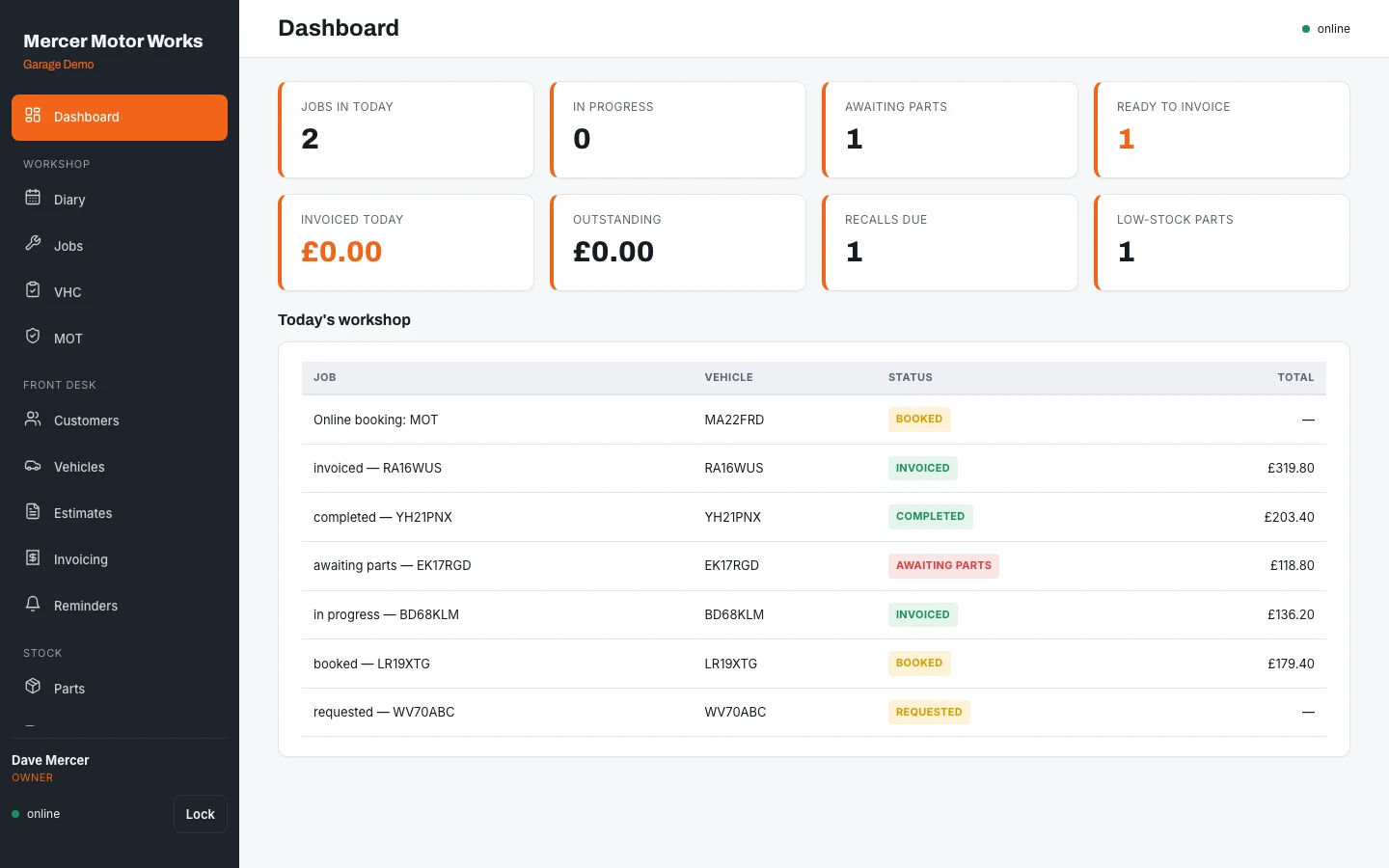
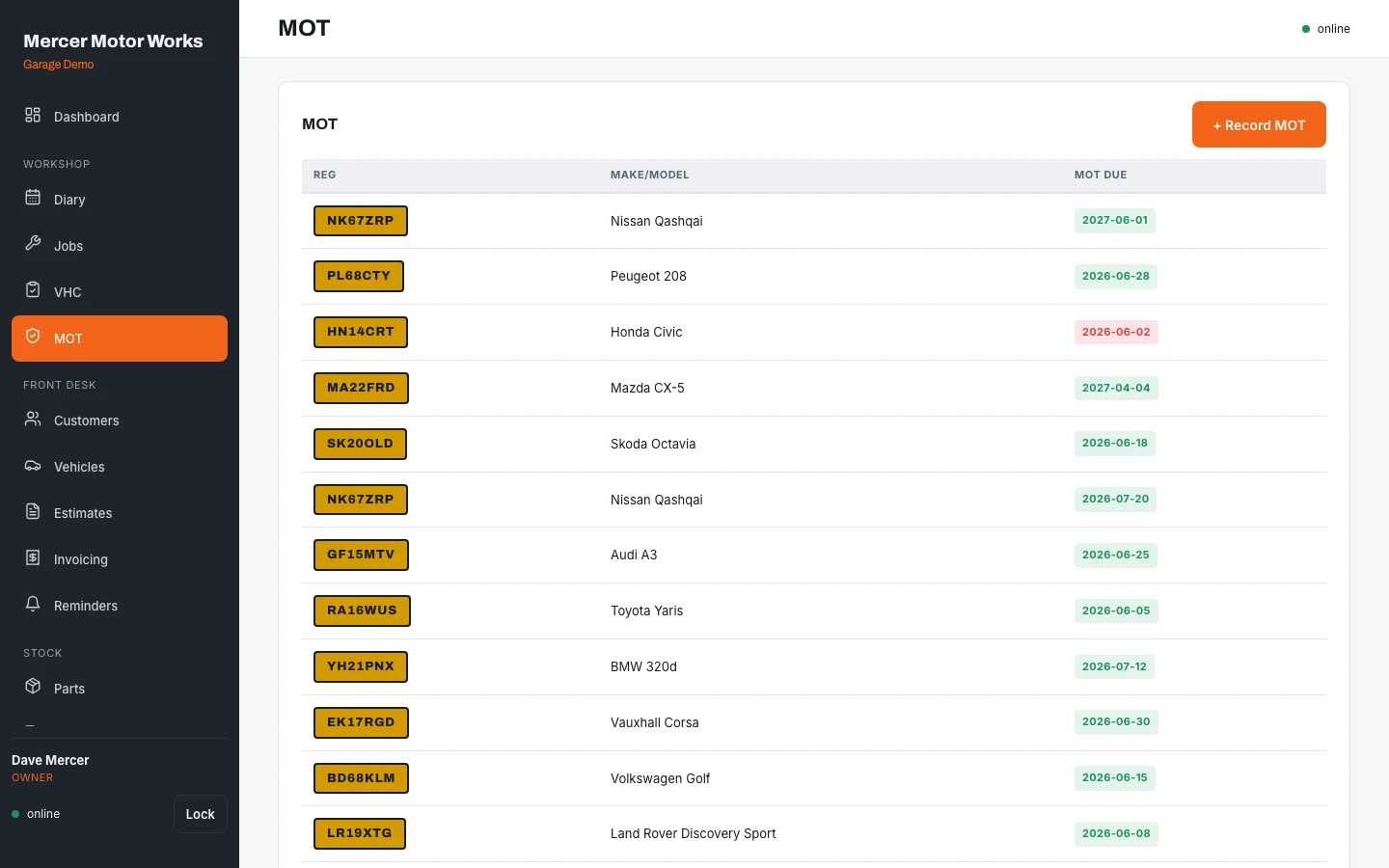
A simplified live demo. Choose a user to explore as, no login needed. Open full screen →
The UK garage management software market has several established players. Here is a comparison of what is available, what each one costs, and where each one fits.
| Provider | What They Offer | Pricing |
|---|---|---|
| TechMan | Full workshop management system. Three tiers: Lite (estimates, invoicing, supplier integrations), Advanced (adds tablet access, digital check sheets, customer portal), and Pro (adds technician tracking, web booking, telephony). No setup costs. Unlimited users. | £189 to £415/month depending on tier. |
| Garage Hive | Cloud-based system built on Microsoft Dynamics. Scheduling, estimates, invoicing, reminders, online booking, Autodata integration, Power BI dashboards. Strong feature set but complex pricing structure with additional setup and training fees. | From £145/month. Setup and training costs additional. |
| Dragon2000 | Established platform targeting larger workshops and dealer operations. DMS and garage software combined. Vehicle sales module, WhatsApp integration, parts management. Long-standing in the market. | £99.95 per user/month. 30-day free trial. |
| AutoChain | Newer entrant. Job management, smart scheduling, booking wizard, service history tracking. Monthly rolling contract. Targets smaller independent garages looking for a simpler, cheaper system. | £69.99/month. Unlimited employees. Optional add-ons. |
| MAM Autowork Online | Cloud-based workshop management. Quotes, invoicing, service records, diary management. TeamView add-on for technician access. Established brand in the aftermarket sector. | From £75/month. TeamView add-on from £25/month. |
| Gemini Systems | DMS and garage management aimed at independent garages and small dealer groups. Scalable system. Does not publicly disclose pricing. | Contact for quote. |
These are all competent products built by companies that understand the garage industry. The issue is not quality. The issue is the model. Every one of them charges you monthly for the life of your business. They own the software. You rent it.
Every garage works slightly differently. A single-bay MOT specialist operates nothing like a six-ramp workshop with three technicians, a parts department, and a tyre fitting bay. A mobile mechanic has completely different scheduling needs from a fixed-site garage. A workshop that specialises in German marques needs different technical data access from one that handles everything.
Off-the-shelf software is designed for the average garage. If your garage is average, it works fine. Most are not average.
What typically happens: you adopt the software, discover it does not quite match your workflow, and start building workarounds. A spreadsheet for tracking warranty work because the system's categories do not fit. A whiteboard for the workshop diary because the software's scheduling view does not match how you actually allocate bays. A separate system for tyre stock because the parts module was designed for service parts, not tyres.
The other problem is lock-in. When TechMan or Garage Hive decides to change its interface, remove a feature, or raise prices, you have no say. Your customer data, job history, and vehicle records live on their servers. Migration to another platform means exporting whatever they allow you to export, which is rarely everything. Some providers make leaving deliberately difficult.
There is also the question of connectivity. Most off-the-shelf systems only connect to a fixed list of suppliers and tools. If you use a parts supplier they have not partnered with, or if you need data to flow into a system they have not anticipated, you are stuck. You cannot modify their software. You can only request a feature and hope it makes their roadmap.
A bespoke system starts with your workshop. Not a product demo. Not a feature list. Your actual daily workflow, from the first phone call or online booking through to invoice, payment, and follow-up reminder.
We sit down with you and map exactly how your garage operates. Then we build a system that matches it precisely. The result is software where every screen, every form, and every report reflects how your staff actually work.
Every system starts with your specific requirements. Here are examples of what your system could include:
Apply to become a garage design partner · · Replies within 24 hours
ESRE builds garage management systems for a one-off cost. No monthly subscription. No per-user fees. No price increases. You pay once and you own the system.
The garage management platform is the biggest line item, but it rarely covers everything. For a 4-bay workshop, the monthly spend across tools commonly looks something like this.
| System | Typical Monthly Cost | Examples |
|---|---|---|
| Garage management (GMS) | £145 to £415 | TechMan (£189-415), Garage Hive (~£268 with Business Central), MAM Autowork (from £75) |
| Accounting | £25 to £45 | Xero, QuickBooks, Sage |
| Customer communication/marketing | £20 to £60 | Mailchimp, SMS reminder services |
| Online booking (if separate) | £30 to £80 | BookMyGarage, separate booking widget |
| Total monthly cost | £220 to £600 | |
| Five-year total | £13,200 to £36,000 |
On top of these subscription costs, many garages still run a whiteboard for the workshop diary and a spreadsheet for fleet accounts, because the GMS does not handle those workflows properly. The "integrated" garage is actually three or four systems and two manual processes held together by memory.
| System Scope | Typical One-Off Cost | Replaces |
|---|---|---|
| Core: job cards, estimates, invoicing, MOT/service reminders, customer database | £6,000 to £12,000 | GMS subscription + accounting workarounds |
| Full: above plus online booking, digital VHC, parts integration, technician tracking | £12,000 to £25,000 | GMS + booking + communication subscriptions |
| Multi-site: full system across 2 to 5 branches with central management | £20,000 to £50,000 | Per-branch subscriptions multiplied across locations |
A garage paying £300 per month across its tools spends £18,000 over five years and owns nothing. A bespoke system at £15,000 pays for itself in under three years, replaces every subscription and the whiteboard, and belongs to the garage permanently.
Every system we build, the client owns all the code. There is no vendor lock-in. No proprietary platform you depend on. No API that gets deprecated when the vendor decides to change direction.
Your customer data, vehicle history, job records, and financial information live on infrastructure you control. If you want to switch hosting providers, you can. If you want to add a feature, you can. If ESRE disappeared tomorrow, your software would keep running.
What we build is not one screen. It is a connected data architecture from which multiple applications emerge. Vehicle and customer data is entered once and appears wherever it is needed.
All of these surfaces draw from the same data. A customer who books online sees the same availability the service desk sees. A VHC completed by a technician is immediately visible to the customer and linked to the job card and the invoice.
We train you and your team to evolve the system using AI. Since December 2025, AI tools have reached the maturity to work reliably alongside people for maintaining and extending systems. We set up your AI to understand your specific codebase, with failsafe environments, version control, and automated backups.
Because Technology DNA already holds the data architecture, adding new functionality is straightforward. Want to add fleet account management with PO approvals and consolidated invoicing? It connects to the same customer, vehicle, and job data that already exists. Need a tyre stock module that was not in the original build? It slots into the same system. Technology DNA is the foundation. Everything after that is incremental, and much of it can be done in-house with the tools we provide.
See examples of what we build across different sectors.
TechMan, Garage Hive, and Dragon2000 all charge a monthly subscription. A bespoke workshop management system for your garage, owned outright, no renewals.
Built to handle a multi-bay workshop at full capacity. Vehicle lookup, job cards, parts ordering, and invoicing at the speed a busy MOT and service centre actually needs.
Customer record, full service history, open jobs, outstanding invoices, and reminder schedule. No jumping between three systems to answer one customer's question.
EV servicing, ADAS recalibration, digital MOT records. When industry standards shift, your system shifts with them. No platform migration required.
Switching systems is the part most garage owners dread. Years of customer records, vehicle history, and job data sitting in a platform you are trying to leave. The off-the-shelf vendors know this. It is one of the reasons lock-in works so well.
We handle data migration as a standard part of every build. We extract your existing data from whatever system you are currently using, clean it, restructure it, and import it into your new system. Customer records, vehicle details, service history, outstanding reminders. Nothing gets left behind.
If your current provider makes export difficult, we work around it. We have migrated data from spreadsheets, legacy databases, and proprietary platforms that were never designed to let data out. The goal is always a clean transition with zero data loss.
A core garage management system typically takes six to ten weeks from first conversation to live deployment. More complex systems with online booking, customer portals, multi-branch management, and data migration take ten to fourteen weeks.
Yes. We can build connections to whichever parts suppliers you use, so you can look up, price, and order parts without leaving your system. We can also build in access to technical data sources for labour times and repair procedures.
Your system can connect to the DVSA MOT history API to pull test dates, results, and advisory notices directly into your customer records. This means your reminder system always works from accurate, up-to-date MOT data rather than relying on manual entry.
Yes. We build online booking directly into your website. Customers choose a service type, select an available slot, and the booking goes straight into your workshop diary. No third-party platform. No commission. You own the customer relationship from the first click.
We are always available for support, changes, and enhancements. But because you own the code and we train your AI to understand it, you are not dependent on us for day-to-day changes. That is the point.
Your system is cloud-hosted on secure UK-based servers. Your data belongs to you. Every change is recorded in real time to a write-ahead log (WAL), so nothing is ever lost. You can also back up locally on a schedule for additional peace of mind.
No. We design every system for the people who will actually use it. If your receptionist books jobs and your technicians use tablets on the workshop floor, the system works for both without training manuals. We provide hands-on training as part of every build.
Yes. There is a live garage demo you can open now, without a login. Open it as owner, advisor, technician or customer and use a working system. It is free to try; a production build is a one-off project that you own.