What Farm Management Software Needs to Do
Farming software UK needs to handle a volume of data that most industries would struggle with. Field-by-field crop inputs, livestock movements, soil test results, spray records, feed logs, weather conditions, machinery hours, labour costs, environmental scheme evidence, regulatory submissions. Every piece of information connects to something else, and the consequences of poor record-keeping range from lost revenue to failed inspections to forfeited grant payments.
The type of holding determines which records matter most. An arable farm needs detailed crop rotation planning, variable rate application maps, and spray records that satisfy BASIS requirements. A livestock operation needs animal registers, movement records for BCMS (or the incoming Livestock Information Service), medicine books, and feed traceability. A mixed farm needs all of it, and the data needs to connect.
At minimum, farm management software needs to handle:
- Field and parcel mapping with RPA-compatible land references, soil types, and historical cropping data
- Crop input recording covering seed, fertiliser, sprays, and cultivation operations with full traceability
- Livestock registers with individual animal records, breeding data, health treatments, and feed logs
- Movement reporting integrated with BCMS (transitioning to LIS by end of 2026) for cattle, and ARAMS for sheep and goats
- Environmental scheme records with photo evidence, geo-tagged actions, and compliance documentation for SFI agreements
- Financial tracking covering input costs per field, gross margins by enterprise, and cash flow forecasting
More advanced systems also cover variable rate application maps using soil sampling data, machinery scheduling and maintenance logs, labour allocation across enterprises, supply chain traceability from field to buyer, and automated submissions to regulatory bodies.
What Different Farm Types Actually Need
Arable holdings
Arable farms live and die by input costs versus yield. The software needs field-level gross margin tracking, detailed spray and fertiliser records that satisfy Red Tractor and FACTS requirements, and integration with precision equipment. Variable rate nitrogen maps based on satellite imagery or soil conductivity scanning are increasingly standard. Harvest yield mapping needs to flow back into the system so next season's plans reflect what actually happened, not what was budgeted.
Livestock holdings
Livestock management software for cattle operations must provide individual animal tracking from birth to death or sale, with medicine records that satisfy the Veterinary Medicines Directorate's record-keeping rules. The current BCMS Cattle Tracing System is being replaced by the Livestock Information Service, with full rollout expected by end of 2026. From 2027, all newborn calves in England will need Bovine Electronic Identification tags. Software that cannot handle this transition will create problems.
Sheep enterprises need flock registers, movement reporting through ARAMS, and breeding records. Dairy operations add daily yield recording per cow, somatic cell count tracking, mastitis and fertility management, and parlour system integration.
Mixed and diversified holdings
Mixed farms are where generic software breaks down fastest. A 400-hectare holding running 200 cattle, 600 ewes, 150 hectares of combinable crops, an SFI agreement, and a farm shop needs software where all these enterprises connect. Feed grown on the arable side needs to reflect as a cost transfer to the livestock enterprises. Environmental scheme actions on specific parcels need to link to cropping restrictions. The farm shop needs stock management tied to the livestock enterprise.
Most off-the-shelf platforms handle one or two of these well and bolt on the rest as afterthoughts.
Government Compliance and Grant Funding
SFI and environmental schemes
DEFRA's Sustainable Farming Incentive has changed significantly for 2026. SFI26 ties every payment to documented delivery. Photos, operation logs, invoices, and dates must be linked to specific land parcels and specific actions. This is a shift from "plan and report" to "do and document." The evidence requirements strongly favour digital systems that can capture geo-tagged photographs, attach them to the right parcel, and generate the audit trail that scheme inspectors need to see.
Farmers must maintain records for the full agreement duration and beyond if required for audit. Paper-based record-keeping is technically possible but impractical at scale when you are managing multiple SFI actions across dozens of parcels.
BCMS and livestock traceability
Cattle keepers must report movements to BCMS within three days. The new Livestock Information Service (LIS) simplifies this into a single combined report where one farm reports the movement and both holdings are updated automatically. Software that integrates with CTS Web Services today, and can adapt to LIS when it arrives, saves significant administrative time and reduces the risk of late or incorrect submissions.
FETF grants for digital adoption
The Farming Equipment and Technology Fund (FETF) 2026 made £50 million available in grants between £1,000 and £25,000 per theme across productivity, animal health and welfare, and slurry management. Over 8,800 applicants secured funding through FETF 2025, with successful offers totalling more than £68 million.
Inside the live farm demo
A simple demo for farms. Open it as the owner and open the livestock register, or as the vet and look at the medicine records. It runs a working holding end to end:
- Livestock register with BCMS and CTS movement logging, LIS-ready records, births, deaths, and a holding register ready for inspection.
- Fields and operations with parcel mapping and geotagged SFI 2026 evidence capture.
- Medicine cabinet that applies VMD withdrawal periods automatically, so the earliest safe sale or slaughter date is worked out for you.
- Enterprise costings across livestock, arable and any diversified activity, in one place.
- Audit-ready compliance trails for SFI, Red Tractor and movement reporting.
We build your system around your farm and you own it outright. The build cost is upfront, but over two to three years you save significantly against subscription fees.
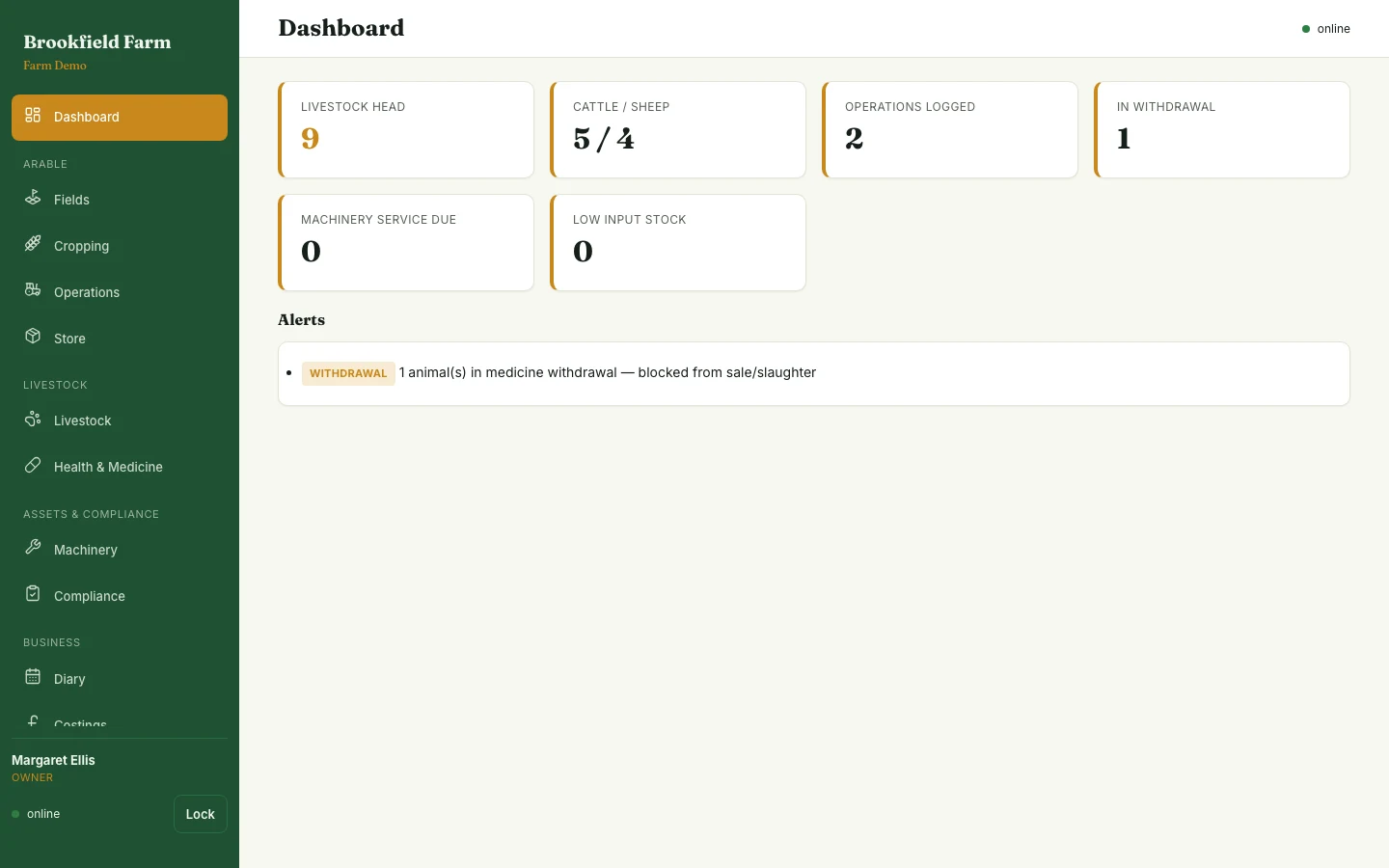
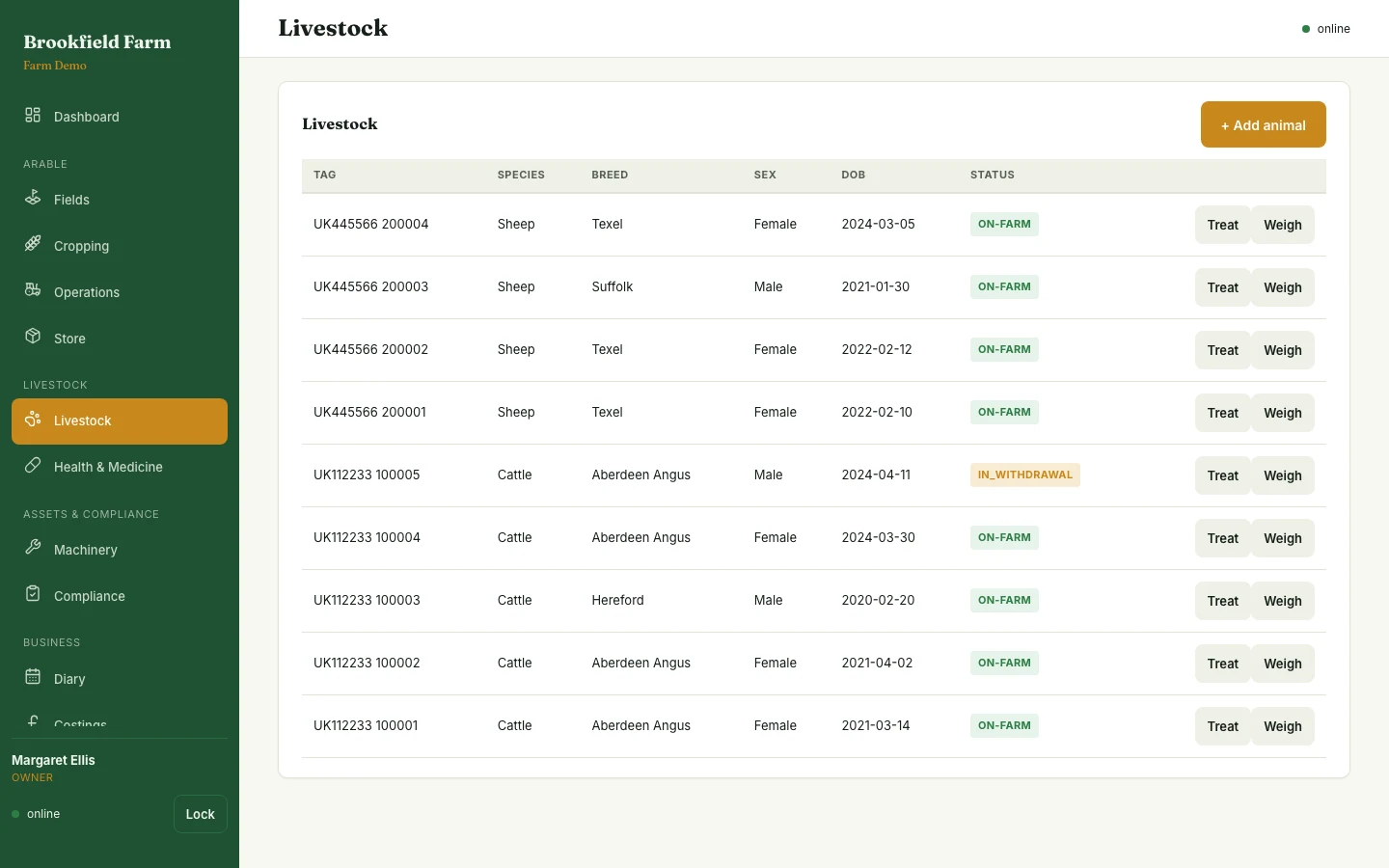
A simplified live demo. Choose a user to explore as, no login needed. Open full screen →
The Main Options in the UK Right Now
The UK farm management software market has been dominated by a small number of providers for years. Recently, ownership changes and new entrants have disrupted the landscape. Here is a look at what is available.
| Provider | What They Offer | Pricing | Best For |
|---|---|---|---|
| Gatekeeper (Farmplan / TELUS) | The most widely used arable system in the UK. Field mapping, crop recording, spray and fertiliser logs, harvest data, gross margins. Now owned by TELUS, with migration to their new Crop Management platform underway through 2026. | Subscription-based, tiered by farm size and modules. Contact for quote. Migration to TELUS Crop Management is scheduled. | Established arable farms comfortable with a desktop-first system. Future unclear as TELUS migrates users. |
| Omnia (Hutchinsons) | Full farm management system with strong agronomy integration. Variable rate maps, soil analysis, crop walking records, financial planning. Mobile app works offline. Backed by Hutchinsons' agronomist network. | From £3.15/ha (Field Manager) to £6/ha (full features), reducing on a sliding scale past 300ha. | Arable farms wanting precision agriculture tools integrated with crop management records. |
| Greenlight Grower Management (Muddy Boots / TELUS) | Cloud-based crop recording and compliance. Now also under TELUS ownership alongside Gatekeeper. Focus on grower management and supply chain traceability. | Subscription-based with no upfront costs. Contact for quote. 30-day free trial available. | Growers supplying retailers who need supply chain traceability and crop assurance records. |
| Figured | Financial management and budgeting platform. Livestock and crop production tracking, forecasting, and reporting. Works through certified advisers. | Subscription through a Certified Figured Adviser. Free one-month trial. Contact for quote. | Farms focused on financial performance, budgeting, and working closely with their accountant. |
| Agrivi | Global platform with UK presence (based in Pershore). Crop and farm planning, pest management alerts, financial tracking. Aimed at farms, cooperatives, and agribusinesses. | Custom pricing based on farm size and requirements. Contact for quote. | Larger operations or cooperatives wanting a data-driven platform with pest and disease alerts. |
The most significant change in this market is the TELUS acquisition. Both Gatekeeper and Greenlight Grower Management are now owned by the same Canadian telecoms company. Gatekeeper users are being migrated to TELUS Crop Management through 2026. For farms that have used Gatekeeper for decades, this creates uncertainty about data continuity, feature parity, and long-term direction.
Where Off-the-Shelf Falls Short
The platforms listed above are functional products. But they were all designed around a generalised idea of what a farm looks like. Your holding is not general.
A 200-hectare arable unit in Lincolnshire operates differently from a 60-cow suckler herd on the Welsh borders. A hill farm with an SFI agreement and a farm shop has workflows that none of these platforms were designed to handle together. A mixed holding in Devon running beef, sheep, arable, and holiday lets has four distinct enterprises that all share costs, labour, and land.
What typically happens is this: you adopt a platform, discover it handles your main enterprise reasonably well but cannot cope with the rest, and start building workarounds. A separate spreadsheet for the livestock finances. A notebook for the SFI evidence because the software's environmental module does not match your agreement actions. A whiteboard in the office for the things the system cannot track.
The Gatekeeper situation illustrates a deeper problem with dependency on third-party platforms. Thousands of UK farms built their entire record-keeping around Gatekeeper over the past 20 years. Now TELUS, a Canadian telecoms company, is migrating them to a new system on a timeline they did not choose. Their historical data, their workflow habits, and their staff training are all at the mercy of a corporate decision made in Vancouver.
Every subscription platform carries this risk. When the vendor changes direction, raises prices, or gets acquired, you have no say. Your farm records, the operational backbone of your business, live on their servers under their control.
Deep Dives
What a Bespoke Farm System Looks Like
A bespoke system starts with your holding. Not a product demo. Not a template designed for a generic 500-hectare arable unit. Your actual daily workflow, from morning livestock checks to spray record entry to SFI evidence capture to end-of-month financial review.
We sit down with you and map exactly how your farm operates. Which enterprises you run, how they interact, what records you actually need versus what existing software forces you to maintain. Then we build a system that matches it precisely.
What we can build for farms
Every system starts with your specific requirements. Here are examples of what your system could include:
- Field management matched to your land. Your actual parcels, your rotation history, your soil types. Not a generic mapping tool. A system where clicking on a field shows you everything that has happened there: crops grown, inputs applied, yields achieved, soil test results, environmental actions completed.
- Livestock tracking built to your enterprise. Whether you run 50 suckler cows or 2,000 ewes, the system reflects your management style. Individual animal records for cattle with BCMS/LIS integration. Flock-level management for sheep with ARAMS reporting. Breeding calendars, health protocols, and medicine books that match how your vet and you actually work.
- SFI and environmental compliance built into daily work. Capture geo-tagged photos, log actions against specific parcels, and generate the evidence trail that scheme inspectors need. Not a separate compliance exercise. Part of the daily routine.
- Financial tracking by enterprise. Know the gross margin on your winter wheat, your spring lamb, and your SFI payments separately. Allocate shared costs (labour, machinery, overheads) properly across enterprises so you know which parts of the farm actually make money.
- Regulatory submissions handled automatically. Cattle movements submitted to BCMS (and LIS when it arrives). Spray records formatted for Red Tractor audits. Medicine records structured for VMD compliance. The system generates the output the regulators want without you reformatting data.
- Weather and soil data where it matters. Your system can include local weather data, soil moisture monitoring, and growing degree day calculations tied to your actual fields. Not regional averages from a weather API 30 miles away.
Connect with us about farm management software · · Replies within 24 hours
What It Costs
ESRE builds farm management systems for a one-off cost. No annual subscription. No per-hectare fees. No price increases when you add another enterprise or bring more land into the system.
Common subscription costs in farming
A mixed farm does not pay for one tool. Crop management, livestock records, environmental compliance, and farm finance each live in different systems with different subscription models. For a 600-hectare mixed holding, the annual spend commonly looks something like this.
| System | Typical Annual Cost | Examples |
|---|---|---|
| Crop management / agronomy | £1,800 to £3,600 | TELUS Crop Management (ex-Gatekeeper) at £3-6/ha, Omnia, SUM-IT |
| Livestock management | £500 to £2,000 | Agrinet, Herdwatch, Breedr, Farmplan Livestock |
| Farm finance / accounting | £500 to £1,500 | Figured, Farmplan Accounts, Sage, Xero |
| Environmental / SFI compliance | £200 to £600 | Often manual, or included in crop platform at extra cost |
| Total annual cost | £3,000 to £7,700 | |
| Five-year total | £15,000 to £38,500 |
None of these platforms share data properly. Crop input costs in the agronomy tool have no connection to the financial system. Livestock movements recorded in one system are invisible to the environmental compliance tool. The farm's true profitability per enterprise is only visible by manually combining data from three or four separate platforms.
What a bespoke system costs
| System Scope | Typical One-Off Cost | Replaces |
|---|---|---|
| Core: field mapping, crop records, spray logs, basic finance | £8,000 to £15,000 | Crop management subscription |
| Full: above plus livestock, BCMS integration, SFI compliance, enterprise financials | £15,000 to £30,000 | All four subscription categories above |
| Multi-enterprise: full system plus diversified income (farm shop, glamping, events) | £25,000 to £55,000 | Farm subscriptions + separate booking/POS/retail systems |
A mixed farm paying £5,000 per year across its tools spends £25,000 over five years and owns nothing. A bespoke system at £20,000 pays for itself within four years, replaces every subscription, and belongs to the farm permanently. For diversified holdings with farm shops, holiday lets, or events, the savings are faster because the bespoke system replaces additional retail and booking subscriptions too.
Your Code, Your Control
Every system we build, the client owns all the code. There is no vendor lock-in. No corporate acquisition that forces you onto a new platform you did not ask for. No API that stops working because a Canadian telecoms company changed its strategy.
Your system is cloud-hosted on secure UK-based servers. Your data belongs to you. Every change is recorded in real time to a write-ahead log (WAL), so nothing is ever lost. You can also back up locally on a schedule for additional peace of mind. No third party can restrict your access to your own information.
One data source, multiple applications
What we build is not one screen. It is a connected data architecture from which multiple applications emerge. Field, livestock, financial, and compliance data is entered once and appears wherever it is needed.
- A field management interface for recording operations, spray applications, and soil data
- A livestock dashboard with herd/flock records, movement history, medicine records, and BCMS compliance
- An SFI evidence tracker that logs compliance actions against scheme requirements as they happen
- A farm finance view showing profitability per enterprise, per field, per livestock group
- A mobile app for recording operations from the field, the yard, or the livestock shed
All of these surfaces draw from the same data. An input cost recorded against a field operation flows through to the enterprise profitability report and the SFI evidence log simultaneously.
Building on top of what already exists
We train you and your team to evolve the system using AI. Since December 2025, AI tools have reached the maturity to work reliably alongside people for maintaining and extending systems. We set up your AI to understand your specific codebase, with failsafe environments, version control, and automated backups.
Because Technology DNA already holds the data architecture, adding new functionality is straightforward. Starting a glamping enterprise? A booking system connects to the same property and financial data. Opening a farm shop? The retail and stock management plugs into the same infrastructure. Adding a new environmental scheme? The evidence tracking builds on the compliance framework already in place. Technology DNA is the foundation. Everything after that is incremental.
See examples of what we build across different sectors.
Most farm software is a recurring licence eating into margins every year. Bespoke is a capital investment. You own it outright, with no annual renewal when yields are tight.
Arable, beef, dairy, mixed. Your workflows, your terminology, your cropping records. The system is built around how your operation actually works.
Sustainable Farming Incentive, Countryside Stewardship, Biodiversity Net Gain. Evidence requirements designed around the specific schemes you are currently on.
Agricultural systems need to work in fields without signal. Data stored locally and synced when connection is available. No dependency on US-hosted infrastructure for systems running British farmland.
Frequently Asked Questions
How long does it take to build?
A core farm management system typically takes six to ten weeks from first conversation to live deployment. More complex systems covering multiple enterprises, regulatory integrations, and data migration from existing platforms take ten to sixteen weeks. We work around the farming calendar, so we can time deployment to avoid harvest or lambing.
Can you import data from Gatekeeper or other existing systems?
Yes. We regularly import historical data from Gatekeeper, spreadsheets, and other farm management platforms. Field histories, livestock records, crop rotation data, and financial records can all be migrated. The goal is a clean transition with no data loss, so you start the new system with your full operational history intact.
Will it work with my existing equipment?
We can build precision agriculture capabilities into your system, including GPS guidance data, yield mapping, soil sampling analysis, and weather station feeds. If your equipment outputs data in standard formats (ISOXML, shapefiles, or CSV), your system can import it directly.
What about ongoing support?
We are always available for support, changes, and enhancements. But because you own the code and we train your AI to understand it, you are not dependent on us for day-to-day changes. That is the point. When DEFRA changes the SFI requirements or LIS replaces CTS, you can adapt the system yourself or ask us to handle it.
Where is the system hosted?
Your system is cloud-hosted on secure UK-based servers. Your data belongs to you. Every change is recorded in real time to a write-ahead log (WAL), so nothing is ever lost. You can also back up locally on a schedule. For farms with poor connectivity, we can build offline capability into the system so critical functions work without an internet connection and data synchronises when you are back online.
Can multiple people use it at the same time?
Yes. The system supports multiple users with role-based access. The farm manager sees everything. Stockworkers see livestock records. Spray operators see relevant field data. Your accountant sees financial reports. Each person gets the views and permissions appropriate to their role.
Can I try the farm management software before committing?
Yes. There is a live farm demo you can open now, without a login. Open it as owner, worker or vet and use a working system. It is free to try; a production build is a one-off project that you own.
Sources and further reading
- Structure of the agricultural industry in England and the UK, GOV.UK (Defra)
- Farming Equipment and Technology Fund (FETF) 2026, GOV.UK
- Use the Cattle Tracing System (CTS) Online, GOV.UK (BCMS)
- Livestock Information Transformation Programme (LITP), GOV.UK (Defra)
- Sheep and goat keepers: how to keep a holding register, GOV.UK
- Veterinary Medicines Directorate, GOV.UK
- Sustainable Farming Incentive 2026 (SFI26), GOV.UK (Defra)
- Red Tractor assurance