What Construction Software Needs to Do
A construction business runs on coordination. Materials arrive on site while subcontractors finish the previous phase. Variations get agreed verbally and need recording before they become disputes. Drawings change mid-build. Health and safety documentation must be current at all times. The gap between what happened and what was recorded is where problems live. Good construction project management software closes that gap. See our comparisons of construction project management software and construction estimating software for the main UK options.
At minimum, construction management software needs to handle:
- Project scheduling and tracking with Gantt charts, milestone tracking, and dependency management across multiple live sites
- Cost estimating and budgeting with material databases, labour rate calculations, and margin tracking against actuals
- Document control with drawing revision management, RFIs, submittals, and version histories that hold up in disputes
- Subcontractor coordination covering procurement, purchase orders, payment applications, and retention tracking
- Health and safety reporting with RAMS, site inductions, incident recording, and RIDDOR compliance
- Defect and snagging management with photo capture, location tagging, and sign-off workflows
- Client communication with progress reports, variation orders, and payment milestone tracking
More advanced systems also cover BIM integration, procurement and supply chain management, plant and equipment tracking, real-time site reporting via mobile, and analytics dashboards that surface problems before they become costly.
The Building Safety Act and Digital Records
The Building Safety Act 2022 introduced the "golden thread" of building information. Section 97 requires that building information is stored in a structured, digital format throughout a building's entire lifecycle, from design through construction and into occupation.
This requirement applies to higher-risk buildings of 18 metres or 7 storeys and above with at least two residential units. It came into force on 1 October 2023. The golden thread includes approved drawings and plans, fire and emergency files, construction control plans, mandatory occurrence reports, and any documents forming part of a Gateway application to the Building Safety Regulator.
Most off-the-shelf construction platforms were not designed with the golden thread in mind. They bolted on compliance features after the Act was passed. A bespoke system can build golden thread compliance into the core data structure from the start, so every document, drawing revision, and decision record is automatically captured in the format the Building Safety Regulator expects.
Inside the live construction software demo
A simple demo for construction firms. Open it as a project manager and open the live project, or as a subcontractor and see the tasks assigned to you. It runs the job from estimate to sign-off:
- Project management with tasks, stages and responsibilities across the build.
- Estimating that feeds the budget and the client documents without re-keying.
- Subcontractor scheduling and document exchange in one place.
- Site documents versioned and linked to the right job and parcel of work.
- Part L and Building Safety Levy compliance records captured as the work happens.
We build your system around your business and you own it outright. The build cost is upfront, but over two to three years you save significantly against subscription fees.
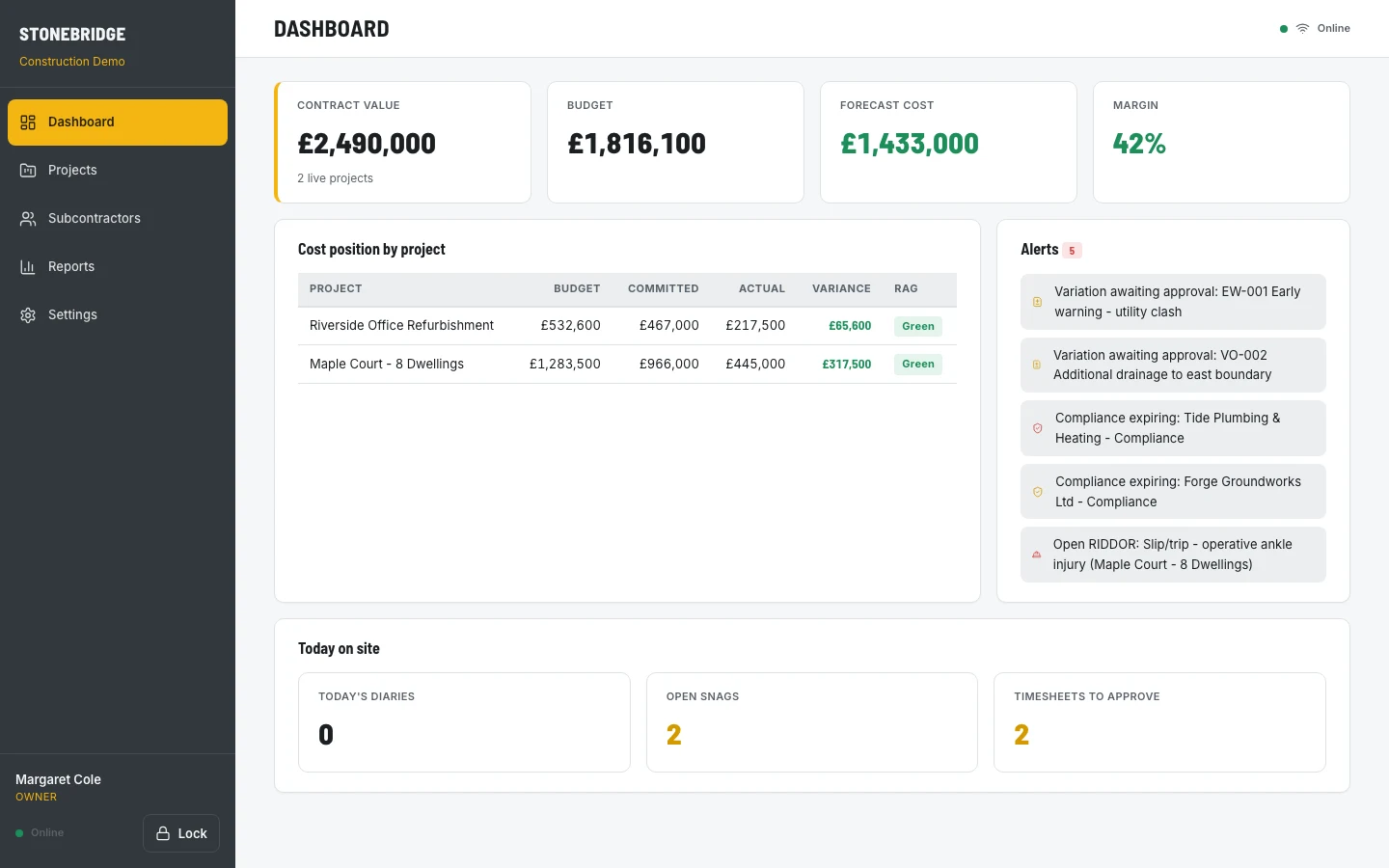
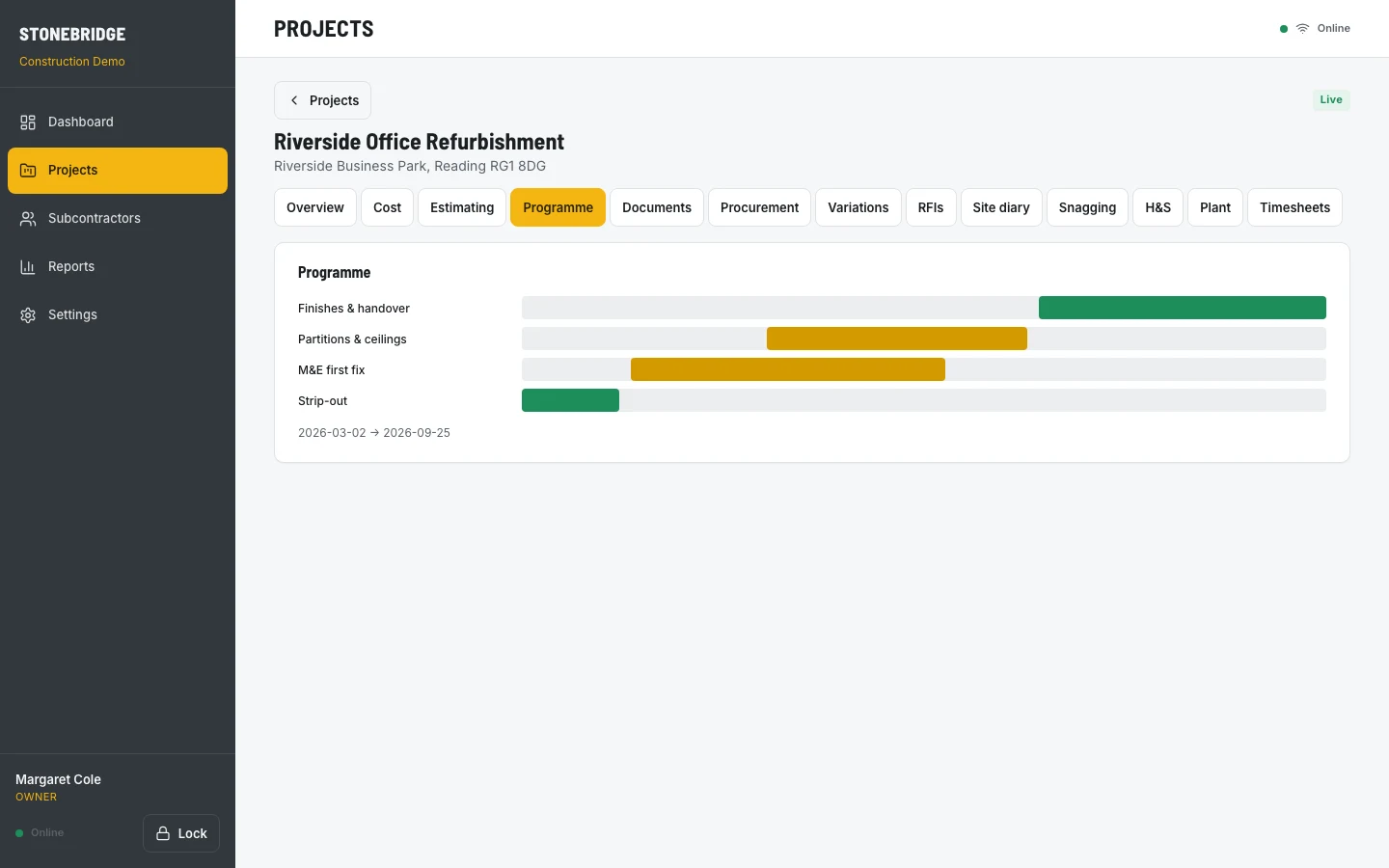
A simplified live demo. Choose a user to explore as, no login needed. Open full screen →
The Main Options in the UK Right Now
The UK construction software market is competitive but concentrated. A few large platforms dominate, each built for a particular segment. Here is a look at what is available.
| Provider | What They Offer | Pricing | Best For |
|---|---|---|---|
| Procore | The largest global construction platform. Project management, quality and safety, financials, workforce management. Comprehensive but complex. Priced on annual construction volume, not users. | £8,000 to £40,000+/year based on annual construction volume. Custom quotes only. | Large commercial contractors with £10m+ annual turnover and dedicated admin teams. |
| Buildertrend | Residential-focused platform. Scheduling, estimating, client portal, financial tools. Strong mobile app. US-designed, so some UK-specific features (VAT handling, UK contract terms) feel adapted rather than native. | £270 to £660+/month. Three tiers. Onboarding fees of £300 to £1,200 on top. Reports of price increases after year one. | Residential builders and home improvement companies comfortable with US-style software. |
| Sage Construction | Part of the Sage ecosystem. Strong on accounting and financial management for construction. Integrates with Sage 200 and Sage Intacct. Less focused on site-level project management. | Contact for quote. Sage 200 starts from roughly £4,700/year. Construction modules are additional. | Firms already using Sage for accounts who want construction-specific financials within the same ecosystem. |
| PlanRadar | Defect management, task tracking, and documentation. Strong for snagging and quality control. Mobile-first. Good for site inspections. Limited on full project management and estimating. | From £25/user/month (Basic). Pro plans at £125/user/month. Enterprise pricing on request. | Firms needing mobile snagging and defect management. Not a full project management platform. |
| Fieldwire | Task management and field collaboration. Drawing markup, punch lists, inspections. Acquired by Hilti in 2021. Good for site teams. Limited on office-side project management, estimating, or financials. | From £30/user/month. A 25-person team costs roughly £9,000/year in user fees alone. | Site supervisors and foremen who need mobile task management. Not a full business system. |
| CoConstruct | Residential construction and remodelling. Estimating, project management, client selections, financial tracking. Merged with Buildertrend's parent company in 2022. | From £40 to £80+/user/month. Per-user pricing means costs scale with team size. | Custom home builders and remodellers. Less suited to commercial or multi-site operations. |
Every platform in this table charges ongoing fees. Procore's volume-based pricing means your costs rise as your business grows. Buildertrend and CoConstruct charge monthly subscriptions that compound over years. PlanRadar and Fieldwire use per-user pricing, so adding staff to the system increases your bill directly. In all cases, you are renting software that someone else controls.
Where Off-the-Shelf Falls Short for Construction
Construction is not one industry. It is dozens of specialisms operating under one label. A groundworks contractor has almost nothing in common with a fit-out specialist. A regional housebuilder runs differently from a civil engineering firm. A roofing company's workflow bears no resemblance to a mechanical and electrical contractor's.
Off-the-shelf software tries to serve all of them with the same product. The result is predictable.
The estimating problem
Every construction business estimates differently. Some price from first principles using measured quantities. Others work from historical job costs. Some use unit rates from frameworks. A plastering contractor's estimate looks nothing like a structural steel fabricator's. Off-the-shelf construction estimating software imposes a single methodology, and if it does not match yours, you end up running the software alongside a spreadsheet.
The integration problem
Construction businesses use multiple disconnected systems for accounts, suppliers, BIM, and site management. Off-the-shelf platforms offer a fixed set of integrations. If your existing tools are not on their list, you are stuck with manual data entry or CSV exports. The "connected" platform turns into another data silo.
The UK-specific problem
Most major construction platforms were built in the United States. Procore, Buildertrend, and CoConstruct were all designed for American construction practices. CIS tax deductions, UK retention rules, JCT and NEC contract structures, CITB levy calculations, Building Safety Act compliance. These are afterthoughts in US-designed software, if they are addressed at all.
The scaling problem
Per-user and volume-based pricing penalises growth. A firm that wins more contracts or hires more staff pays more for the same software. With Procore, your subscription increases as your annual construction volume grows. With Fieldwire, every new site supervisor you add to the system costs another £30 per month. The software becomes more expensive precisely when your margins are under the most pressure.
Deep Dives
What a Bespoke Construction System Looks Like
A bespoke system starts with your business. Not a product demo. Not a feature list. Your actual daily workflow, from tender to completion, from site to office, from subcontractor to client.
We map exactly how your construction business operates. Then we build a system that matches it precisely. The result is software where every screen, every form, and every report reflects the way your team actually works.
What we can build for construction firms
Every system starts with your specific requirements. We design it around how your business actually operates, not around a fixed feature list. Here are examples of what your system could include:
- Estimating that matches your methodology. Whether you price from measured quantities, historical costs, or framework rates, the system reflects your approach. Your rate libraries, your markup structures, your tender formats.
- Project tracking built for your contract types. JCT, NEC, or bespoke contract structures with the payment schedules, retention terms, and variation procedures you actually use. Not an American payment application workflow with a UK label on it.
- Document control with proper version management. Drawing registers, RFI logs, submittal tracking, and correspondence records that maintain full audit trails. Built to withstand adjudication, not just to look organised.
- Subcontractor management on your terms. Your procurement process, your order templates, your CIS verification workflow, your retention schedules. Connected to your accounts so payment runs are not a manual reconciliation exercise.
- Site reporting via mobile. Daily diaries, progress photos, safety inspections, snagging lists. Captured on site, synced to the office, linked to the right project and the right drawing. No duplicate entry.
- Health and safety compliance built into daily work. RAMS, method statements, site inductions, toolbox talks, near-miss reporting, and RIDDOR notifications. Generated as part of the workflow, not as a separate compliance exercise.
- Golden thread compliance from the ground up. For firms working on higher-risk buildings, the data structure is designed to meet Building Safety Act requirements natively. Every design decision, construction record, and handover document sits in the structured digital format the Act requires.
Connect with us about construction software · · Replies within 24 hours
What It Costs
ESRE builds construction management systems for a one-off cost. No monthly subscription. No per-user fees. No price increases when your turnover grows. You pay once and you own the system.
Common subscription costs in construction
Construction firms rarely use one platform. Project management, estimating, field coordination, compliance, and accounting each sit in a different tool. For a mid-size contractor with 15-25 staff, the monthly spend commonly looks something like this.
| System | Typical Monthly Cost | Examples |
|---|---|---|
| Project management | £300 to £2,000+ | Procore (volume-based), Buildertrend ($399-1,099/mo), Archdesk (from £330) |
| Field coordination / task management | £300 to £900 | Fieldwire ($54-94/user/mo x 10-15 users), PlanRadar (from £25/user) |
| Estimating | £100 to £300 | Cubit, ConQuest, CANDY, Buildsoft |
| CIS / subcontractor compliance | £50 to £150 | Often manual, or part of accounting package |
| Accounting | £30 to £60 | Sage, Xero, QuickBooks |
| Total monthly cost | £780 to £3,410 | |
| Five-year total | £46,800 to £204,600 |
None of these systems share data properly. An estimate built in Cubit has no connection to the project plan in Buildertrend. A subcontractor payment tracked in Sage has no link to the project budget. Site photos in Fieldwire are invisible to the office. The "integrated" construction business is actually five disconnected platforms and a spreadsheet holding them together.
What a bespoke system costs
| System Scope | Typical One-Off Cost | Replaces |
|---|---|---|
| Core: estimating, project tracking, document control, site reporting | £10,000 to £20,000 | Project management + estimating subscriptions |
| Full: above plus subcontractor management, H&S, procurement, client portal | £20,000 to £45,000 | All five subscription categories above |
| Enterprise: full system across divisions with central reporting and golden thread | £40,000 to £80,000 | Per-user subscriptions multiplied across all staff |
The arithmetic is clear. A mid-size contractor paying Procore £25,000 per year spends £125,000 over five years and owns nothing. The same firm could have a bespoke system built for a fraction of that cost, tailored exactly to their workflow, with no ongoing fees and full code ownership.
Per-user pricing is particularly punishing for construction. A firm with 25 field staff using Fieldwire at £30 per user per month spends £9,000 per year just on task management. Add office staff on a separate platform and you are quickly above £15,000 annually for tools that do not even talk to each other.
Your Code, Your Control
Every system we build, the client owns all the code. There is no vendor lock-in. No proprietary platform you depend on. No API that gets deprecated when the vendor decides to pivot to a different market segment.
This matters particularly in construction. Your project records, cost data, and compliance documentation are business-critical assets. When they sit on Procore's servers or Buildertrend's cloud, you are one contract dispute or one vendor decision away from losing access to your own information. With a bespoke system, your data belongs to you. It is hosted on secure UK-based servers, every change is recorded in real time to a write-ahead log (WAL), and you can back up locally on a schedule.
One data source, multiple applications
What we build is not one screen. It is a connected data architecture from which multiple applications emerge. Project, cost, and compliance data is entered once and appears wherever it is needed.
- An office dashboard with project status, budgets vs actuals, and cash flow across all active jobs
- A site app for foremen and supervisors to log daily reports, take geo-tagged photos, and update progress
- A subcontractor portal where subbies view schedules, submit timesheets, and upload compliance documents
- A client-facing project tracker where clients see progress updates, photos, and milestone completion
- Golden thread documentation generated automatically from the records created during normal operations
All of these surfaces draw from the same data. A photo taken on site by a foreman is immediately visible to the office, the client portal, and the compliance archive. A cost recorded against a subcontractor's work order flows through to the project budget and the financial report.
Building on top of what already exists
We train you and your team to evolve the system using AI. Since December 2025, AI tools have reached the maturity to work reliably alongside people for maintaining and extending systems. We set up your AI to understand your specific codebase, with failsafe environments, version control, and automated backups.
Because Technology DNA already holds the data architecture, adding new functionality is straightforward. Won a contract type you have not done before (commercial fit-out, residential development)? The estimating and project tracking adapt to the new workflow. Need a plant tracking module? It connects to the same project and cost data. Want to add BIM integration or Part L photographic evidence management? These slot into the existing architecture. Technology DNA is the foundation. Everything after that is incremental.
See examples of what we build across different sectors.
Procore, Autodesk Build, and Fieldwire all charge per user. A bespoke project management system with unlimited users, built for how your sites actually work.
Project management, estimating, document control, subcontractor management, site reporting in one connected system. No integration failures mid-project.
A core construction management system covering tenders, projects, variations, programme, and documents typically live in four to eight weeks. No enterprise procurement process.
Add a site manager, a subcontractor portal, a client login. No per-seat licence conversation. The system grows with the project, not the invoice.
The Digital Adoption Gap
There are over 370,000 registered construction firms in Great Britain. The UK construction software market is projected to grow from $2.85 billion in 2025 to $6.72 billion by 2031. 87% of UK construction firms say they are investing in digital tools.
But the reality on site tells a different story. Many SME contractors still run on spreadsheets, WhatsApp groups, and paper drawings. 26% of UK construction workers cite high implementation costs as the biggest barrier to adopting digital tools. The platforms that dominate the market were designed for large contractors with dedicated IT departments and six-figure software budgets.
The mid-market is underserved. Firms with 10 to 100 employees are too large for spreadsheets but too small for Procore. They need software that fits their specific workflows without the overhead of enterprise platforms or the limitations of tools designed for sole traders.
This is where bespoke makes the most sense. A system built for a regional contractor with 30 staff costs less than two years of Procore, does exactly what that business needs, and does not charge more when the firm hires employee number 31.
Frequently Asked Questions
How long does it take to build?
A core construction management system typically takes six to ten weeks from first conversation to live deployment. More complex systems with multiple modules, financial reporting, and data migration from current tools take ten to sixteen weeks. We deploy in stages so your team can start using the system before the full build is complete.
What about invoicing and financial tracking?
We can build invoicing and financial reporting directly into your system, so everything from subcontractor payments to project costs flows through one place. No double entry, no separate platforms.
What about mobile access on site?
Every system we build is mobile-responsive as standard. For construction, we can build dedicated mobile views optimised for site conditions: large buttons, photo capture, offline capability for areas with poor signal, and sync when connectivity returns.
Can you handle CIS tax deductions?
Yes. We build CIS verification, deduction calculation, and HMRC reporting into the subcontractor payment workflow. It is not an add-on or a separate module. It is part of how the system processes subcontractor payments.
What about ongoing support?
We are always available for support, changes, and enhancements. But because you own the code and we train your AI to understand it, you are not dependent on us for day-to-day changes. That is the point.
Can I try the construction software before committing?
Yes. There is a live construction demo you can open now, without a login. Open it as owner, project manager, supervisor, subcontractor or client and use a working system. It is free to try; a production build is a one-off project that you own.
Sources and further reading
- Building Safety Act 2022, legislation.gov.uk
- The golden thread, GOV.UK
- Register a high-rise residential building, GOV.UK
- Building Safety Regulator (HSE)
- What is the Construction Industry Scheme (CIS), GOV.UK
- Approved Document L (2026), GOV.UK