What Catering Software Needs to Do
A catering business is not a restaurant. A restaurant serves the same menu to whoever walks in. A caterer builds a different menu for every event, delivers it to a different location, manages different dietary requirements for every guest list, and invoices against a quote that was agreed weeks or months earlier. The operational chain from enquiry to kitchen production to delivery to invoice is longer, more variable, and harder to manage than almost any other food business.
Most caterers end up running three or four disconnected tools. A CRM or email for enquiries and client communication. A spreadsheet for menu costing and event details. A separate system (or another spreadsheet) for production planning and kitchen prep sheets. Xero or QuickBooks for invoicing. The same event details get re-entered at every stage. The dietary requirements captured during the initial enquiry may or may not make it to the kitchen production sheet on the day.
At minimum, catering management software needs to cover:
- Enquiry and event management from initial contact through proposal, tasting, confirmation, and event-day coordination
- Menu building and costing with ingredient-level cost tracking, margin calculations, and the ability to create custom menus per event
- Allergen tracking through every recipe and menu variation, with the ability to flag conflicts when a guest's dietary requirements do not match the selected menu
- Production planning that turns confirmed event menus into kitchen prep sheets, shopping lists, and staff allocation
- Dietary requirement management per guest, linked to the event, visible to the kitchen on the day
- Invoicing and deposit tracking with staged payments (deposit on booking, balance before event, final invoice after), credit control, and accounting integration
- Staff scheduling for event-day teams, with different staffing profiles for different event types
Inside the live catering software demo
A simple demo for caterers. Open it as kitchen and see the production list for the day, or as events and enter an order. It runs the event-to-plate workflow:
- Event orders that flow straight into kitchen production without retyping.
- Menu costing that updates when ingredient prices change.
- Kitchen production sheets and prep lists generated from the bookings.
- Allergen management (Natasha's Law) with matrix and label output.
- Invoicing tied to the same event and client record.
We build your system around your business and you own it outright. The build cost is upfront, but over two to three years you save significantly against subscription fees.
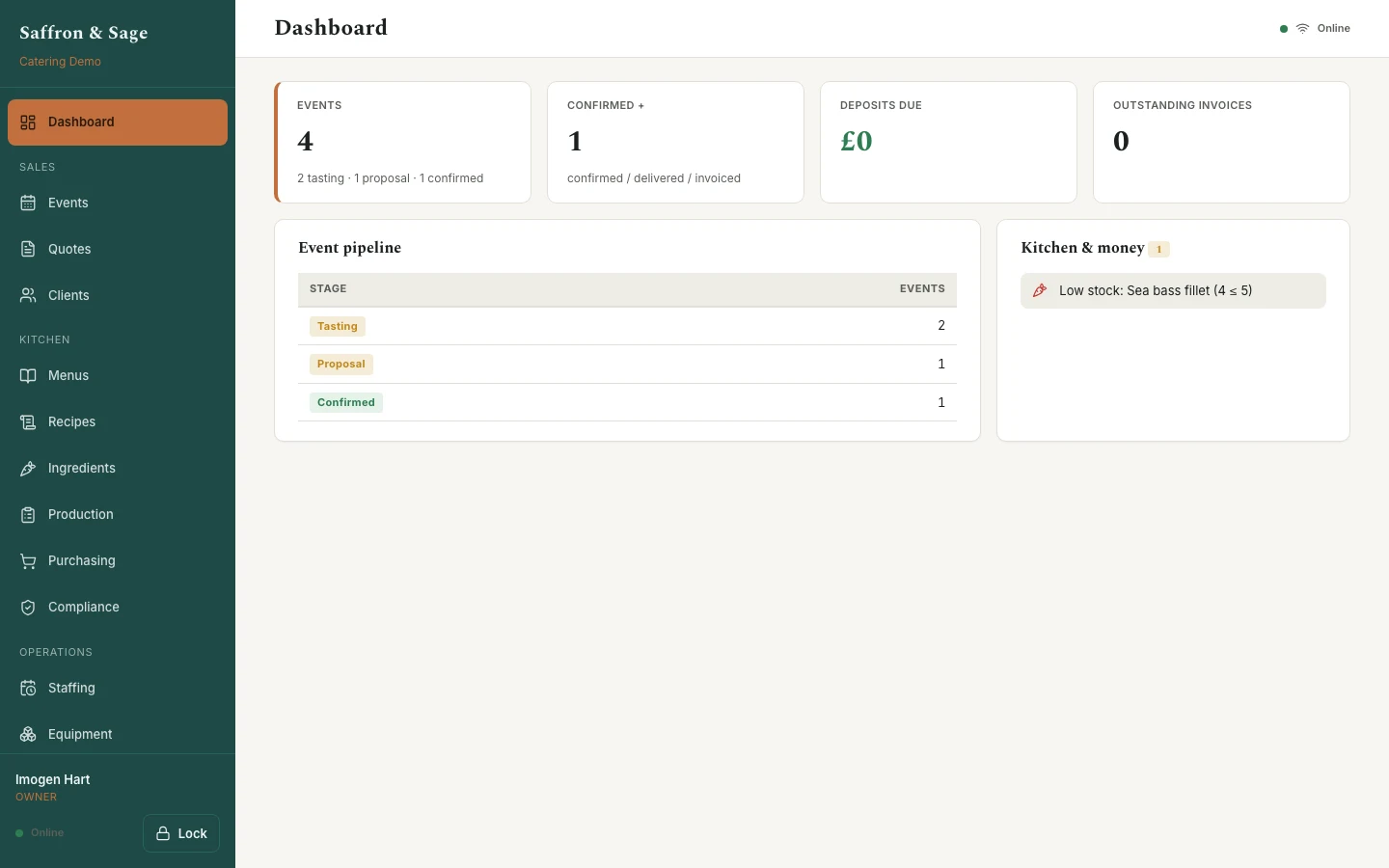
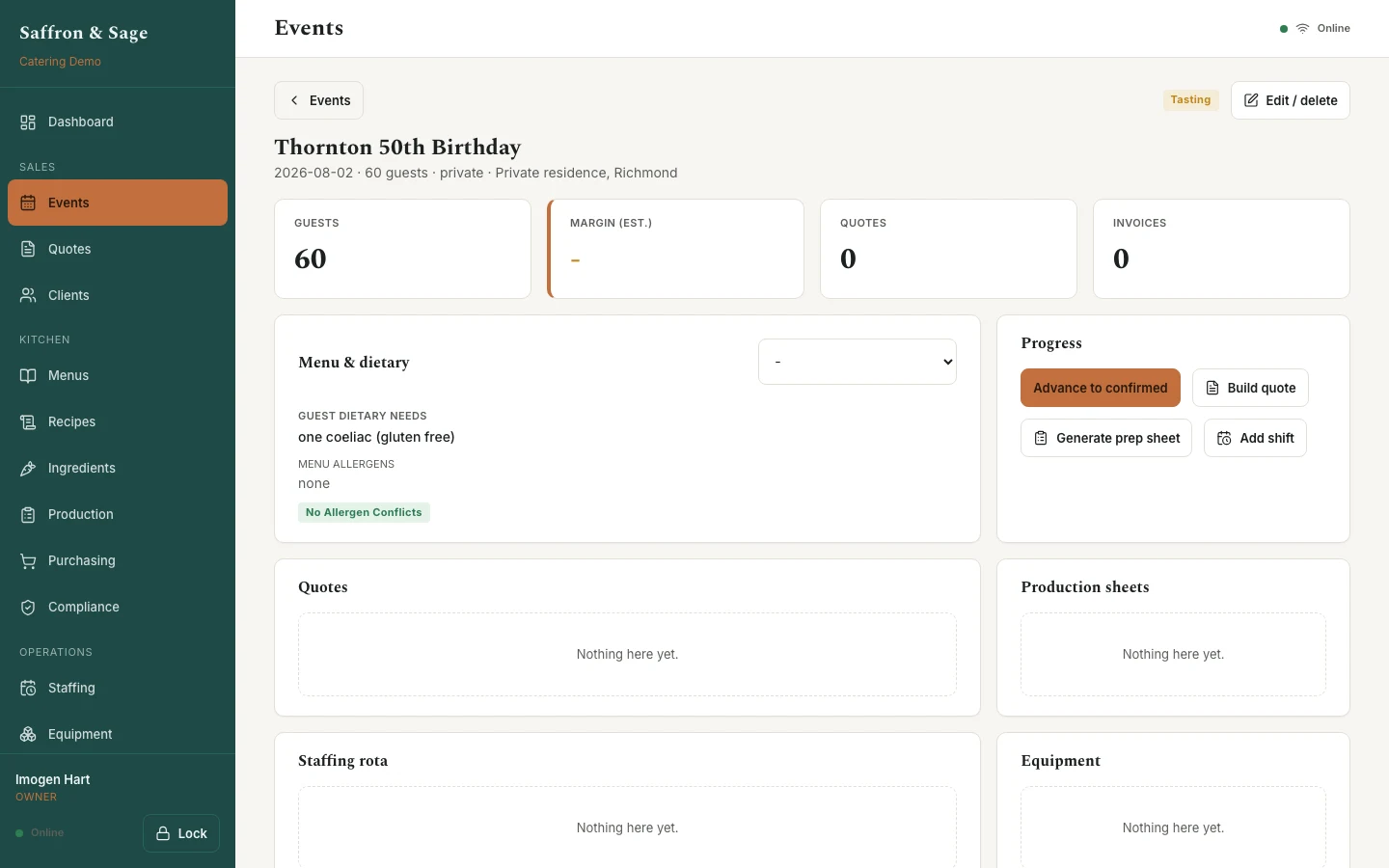
A simplified live demo. Choose a user to explore as, no login needed. Open full screen →
The Main Options in the UK Right Now
The catering software market has a distinctive problem: most of the established platforms are American or Australian. Very few are UK-built, and those that are tend to cover only part of the workflow. Here is what is available.
| Provider | What They Offer | Pricing | Best For |
|---|---|---|---|
| Spoonfed | UK-based. Cloud order management for B2B and corporate catering. Strong on recurring office orders, meetings, conferences. Financial reporting and delivery logistics. | Contact for pricing | Corporate and contract caterers (office lunches, meetings, conferences). Less suited to event catering. |
| CaterSOFT Occasion | UK-based. Booking management for wedding and event caterers. Proposals, function sheets, deposit tracking, event planning. Purpose-built for outside catering. | Monthly subscription (affordable, per reviews) | Wedding caterers and outside event caterers. Does not cover kitchen production or allergen tracking. |
| Kafoodle | UK-based (acquired by 365RM). Recipe management, allergen tracking, food costing, nutritional analysis, PPDS labelling. Compliance-focused. | Contact for pricing | Caterers who need allergen compliance and recipe costing. Does not cover event CRM or production planning. |
| Caterease | US-based. 50,000+ users globally. Complex booking management, staff scheduling, packing lists, floor plans. The most feature-rich event catering platform. | Contact for pricing (USD) | Large event catering operations. US-centric. No native UK VAT or allergen compliance. |
| Flex Catering | Australian. Drop-off and event catering management. Online ordering, delivery scheduling, menu management. | Contact for pricing (AUD) | Drop-off catering and meal delivery services. Australian origin, limited UK features. |
| Total Party Planner | US-based. All-in-one catering and event planning. Proposals, BEOs, timelines, payments, reporting. | From ~$99/month (USD) | Event caterers comfortable with US tools. No UK allergen compliance or VAT. |
The pattern is clear. If you do corporate catering, Spoonfed covers orders and delivery. If you do wedding catering, CaterSOFT handles bookings and proposals. If you need allergen compliance, Kafoodle tracks recipes and labels. But no single UK tool connects the enquiry to the menu costing to the production sheet to the invoice. You are left filling the gaps with spreadsheets and manual re-entry.
Where Off-the-Shelf Falls Short
The copy-paste tax is the central problem. An enquiry comes in. You capture the details in your CRM or email. You build a proposal with menu options, costings, and staffing. The client confirms. You re-enter the event details into your production planning system. You create kitchen prep sheets manually from the confirmed menu. You generate the invoice in your accounting tool by re-entering the line items from the proposal. At every stage, the same information is re-typed. At every stage, there is a chance something gets missed, changed, or entered differently.
Dietary requirements fall through the cracks. A wedding guest indicates a severe nut allergy on the RSVP. That information sits in an email or a spreadsheet. Three months later, on the event day, the kitchen is prepping 120 covers. Did the nut allergy make it to the production sheet? In a connected system, it would be flagged automatically. In a disconnected workflow, it depends on whether someone remembered to copy it across. The consequences of getting this wrong are not administrative. They are medical.
US and Australian tools do not handle UK requirements. No VAT handling (or incorrect VAT handling). No Natasha's Law compliance. No awareness of UK food hygiene rating schemes. Customer support in the wrong timezone. Pricing in USD or AUD with exchange rate fluctuation. These are not minor inconveniences. They are daily friction that compounds over time.
Corporate and event catering are different businesses. Corporate catering means recurring daily orders, per-head billing, delivery routes, and standing menus with occasional variations. Event catering means one-off custom menus, staged deposits over months, production scaling for variable guest counts, and on-site service coordination. No single off-the-shelf tool handles both well. Spoonfed is built for corporate. CaterSOFT is built for events. If you do both, you are running two systems.
Menu costing is too important for a spreadsheet. Ingredient prices change. A caterer who costed a menu in January for a July wedding may have locked in a price based on ingredient costs that have shifted significantly. A system that tracks ingredient costs and recalculates margins in real time tells you whether a quoted menu is still profitable before the event, not after.
Connect with us about catering software · · Replies within 24 hours
Deep Dives
What a Bespoke Catering System Looks Like
A bespoke system starts with your operation. Not a generic event management template. Your actual workflow from the moment an enquiry arrives to the moment the final invoice is paid.
We sit down with you and map exactly how your catering business operates. Then we build a system that matches it precisely. The result is a system where event details entered once flow through every stage without re-entry.
What we can build for catering companies
- Enquiry to invoice in one system. A client enquiry creates an event record. The proposal is built from that record. When confirmed, it becomes the production brief. The invoice is generated from the confirmed details. Nothing is re-typed. Nothing is lost between stages.
- Allergen tracking from recipe to plate. Every recipe stores its full ingredient list with the 14 major allergens flagged. When you build an event menu, allergens are visible. When a guest's dietary requirements conflict with a menu item, the system flags it. On the event day, the kitchen production sheet shows every allergen for every dish. For PPDS items, compliant labels are generated automatically.
- Production planning that scales. Confirmed menus convert into prep sheets with quantities scaled to the guest count. Shopping lists aggregate ingredients across multiple events happening in the same week. Kitchen staff see exactly what needs to be prepped, in what quantities, for which event.
- Menu costing with live margins. Build menus with ingredient-level costs. When ingredient prices change, margins update automatically. You know whether a menu quoted three months ago is still profitable before the event, not after the final count.
- Deposit and payment tracking. Staged payments (booking deposit, interim payment, final balance) tracked per event. Automated reminders before payment deadlines. Integration with Xero or QuickBooks for accounting.
- Staff scheduling per event. Different event types need different team profiles. A sit-down wedding dinner needs different staffing from a corporate buffet for 200. The system allocates staff based on the event type and guest count.
The Catering Software Market in the UK
The UK catering services sector has grown at 9% annually since 2020, reaching over 7,000 businesses and projected to pass £16.5 billion in total revenue by 2026. Growth is driven by corporate catering recovery post-pandemic, the expansion of event catering into non-traditional venues, and the increasing complexity of dietary and allergen requirements.
Despite this growth, the software market has not kept pace. The major catering management platforms are almost all US or Australian-built. Spoonfed and CaterSOFT are the notable UK exceptions, but each covers only part of the workflow. The gap between "I need a CRM for enquiries" and "I need a production planning tool for the kitchen" and "I need Natasha's Law compliant allergen tracking" is currently filled by spreadsheets, email, and manual processes.
There are no regulatory barriers to building catering management systems. Food safety compliance (Safer Food Better Business, HACCP) and allergen tracking (Natasha's Law) are operational requirements, not software accreditation barriers. Unlike care homes (which need assured DSCR status) or pharmacies (which need NHS accreditation), a catering system simply needs to support the correct processes. That makes it a straightforward sector for bespoke development.
What It Costs
ESRE builds catering management systems for a one-off cost. No monthly subscription. No per-event fees. No price increases as your business grows.
Common subscription costs in catering
Most caterers use three or four separate tools because no single platform covers enquiries, menus, allergens, production, and invoicing together. For a mid-sized catering operation, the monthly spend commonly looks something like this.
| System | Typical Monthly Cost | Examples |
|---|---|---|
| Event CRM / booking management | £50 to £200 | CaterSOFT, BriteBiz, or generic CRM |
| Recipe costing / allergen compliance | £50 to £120 | Kafoodle, Nutritics, FoodDocs |
| Accounting / invoicing | £25 to £45 | Xero, QuickBooks, Sage |
| Staff scheduling (event day) | £20 to £60 | RotaCloud, Deputy, or manual |
| Total monthly cost | £145 to £425 | |
| Five-year total | £8,700 to £25,500 |
On top of these subscription costs, most caterers spend significant time re-entering event details between systems. A menu costed in Kafoodle has no connection to the proposal in CaterSOFT or the invoice in Xero. A dietary requirement captured at enquiry stage must be manually copied to the production sheet. One integrated system eliminates this duplication entirely, saving hours each week and reducing the risk of allergen errors that carry serious consequences.
What a bespoke system costs
| System Scope | Typical One-Off Cost | Replaces |
|---|---|---|
| Core: event CRM, menu building, proposals, invoicing | £6,000 to £12,000 | CRM + accounting subscriptions |
| Full: above plus allergen tracking, production planning, staff scheduling | £12,000 to £25,000 | All four subscription categories above |
| Multi-service: corporate and event catering with different workflows | £20,000 to £40,000 | All subscriptions + separate corporate ordering platform |
A caterer paying £250 per month across its tools spends £15,000 over five years and owns nothing. A bespoke system at £15,000 pays for itself in under three years, replaces every subscription and the manual data transfer between them, and belongs to the business permanently. The time saved by not re-entering event details across three or four systems is worth thousands more annually.
Your Code, Your Control
Every system we build, the client owns all the code. There is no vendor lock-in. No proprietary platform you depend on. No API that gets deprecated when the vendor changes direction.
One data source, multiple applications
What we build is not one screen. It is a connected data architecture from which multiple applications emerge. Event, menu, allergen, and financial data is entered once and appears wherever it is needed. No more copying details between three systems. No more risk of a dietary requirement not reaching the kitchen.
- A sales and event management interface for enquiries, proposals, tastings, and bookings
- A kitchen production view that turns confirmed menus into prep sheets with quantities scaled to guest count
- An allergen tracking layer that flags every allergen from recipe through to plate, and generates PPDS labels
- A client portal where event organisers finalise menus, submit dietary requirements, and view invoices
- Financial reporting with margins per event, ingredient cost tracking, and seasonal profitability
All of these surfaces draw from the same data. A dietary requirement submitted by a client is immediately visible in the kitchen production view and flagged against the menu allergens. A menu cost change updates the proposal, the margin calculation, and the invoice simultaneously.
Building on top of what already exists
We train you and your team to evolve the system using AI. Since December 2025, AI tools have reached the maturity to work reliably alongside people for maintaining and extending systems. We set up your AI to understand your specific codebase, with failsafe environments, version control, and automated backups.
Because Technology DNA already holds the data architecture, adding new functionality is straightforward. Expanding into corporate catering alongside events? A recurring order module connects to the same menu, allergen, and financial data. Want to add an online ordering portal? It draws from the same menu and pricing records. Need a delivery route planner? It builds on the event location data already in the system. Technology DNA is the foundation. Everything after that is incremental.
See examples of what we build across different sectors.
Replace your CRM, your compliance tool, your production spreadsheets, and your workarounds with one system you own. One cost. Yours forever.
Kitchen staff, event managers, sales team, accounts. Everyone accesses the system at no extra cost. Hire more people without your software bill increasing.
Your client data and business records on servers in the UK. No US or Australian vendor routing your data through infrastructure you have no visibility of.
A core catering system covering event CRM, menu building, and invoicing typically takes four to eight weeks from first conversation to live deployment.
Frequently Asked Questions
How long does it take to build?
A core catering system typically takes four to eight weeks from first conversation to live deployment. More complex systems with allergen tracking, production planning, and multi-service workflows take eight to fourteen weeks.
Can it handle allergen compliance?
Yes. We build systems that track the 14 major allergens through every recipe, every menu variation, and every production sheet. For PPDS food, the system generates compliant labels. Allergen data flows from the recipe through to the event-day kitchen sheet without manual transcription.
Can it handle both corporate and event catering?
Yes. Corporate catering (daily orders, recurring contracts, per-head billing) and event catering (custom menus, staged deposits, variable guest counts) have completely different workflows. A bespoke system handles both under one roof with separate processes for each.
What about ongoing support?
We are always available for support, changes, and enhancements. But because you own the code and we train your AI to understand it, you are not dependent on us for day-to-day changes. That is the point.
Where is the system hosted?
Your system is cloud-hosted on secure UK-based servers. Your data belongs to you. Every change is recorded in real time to a write-ahead log (WAL), so nothing is ever lost.
Can I try the catering software before committing?
Yes. There is a live catering demo you can open now, without a login. Open it as owner, events manager, kitchen, accounts or client and use a working system. It is free to try; a production build is a one-off project that you own.
Sources and further reading
- Natasha's Law: PPDS allergen labelling, Food Standards Agency
- Allergen guidance for food businesses, Food Standards Agency
- Hazard analysis and critical control point (HACCP), Food Standards Agency
- Food Hygiene Rating Scheme, Food Standards Agency